#include "safe_config.h"#include "safe_lib_errno.h"#include "safe_types.h"#include "safe_compile.h"#include "safe_str_lib.h"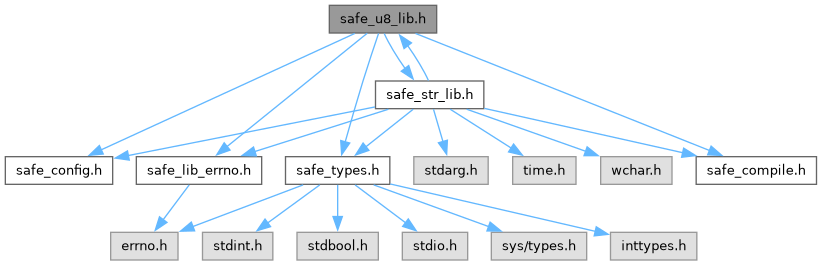

Macros | |
| #define | u8cat_s(dest, dmax, src) |
| The u8cat_s function appends a copy of the utf-8 string pointed to by src (including the terminating null character) to the end of the utf-8 string pointed to by dest. | |
| #define | u8cpy_s(dest, dmax, src) |
The u8cpy_s function copies the string pointed to by src (including the terminating null character) into the buffer pointed to by dest. | |
| #define | u8icpy_s(dest, dmax, src) |
The u8icpy_s function normalizes and checks the utf-8 string pointed to by src and copies it into the buffer pointed to by dest. | |
| #define | u8icat_s(dest, dmax, src) |
| The u8icat_s function appends a copy of the utf-8 string src (including the terminating null character) to the end of the utf-8 normalized identifier-like dest. | |
| #define | u8ncat_s(dest, dmax, src, slen) |
| The u8ncat_s function appends not more than slen bytes from the utf-8 string pointed to by src to the end of the utf-8 string pointed to by dest. | |
| #define | u8ncpy_s(dest, dmax, src, slen) |
| The u8ncpy_s function copies the utf-8 string pointed to by src (including the terminating null character) into the utf-8 string pointed to by dest. | |
| #define | u8len_s(str) |
| The u8len_s function computes the byte-length of the null-terminated utf-8 string pointed to by str, not examining more than RSIZE_MAX_STR bytes. | |
| #define | u8nlen_s(str, smax) |
| The u8nlen_s function computes the byte-length of the utf-8 string pointed to by str, stopping at smax, providing limited support for non-null terminated strings. | |
| #define | u8width_s(str, smax) |
| The u8width_s function computes the number of "graphemes" of the utf-8 string pointed to by str, stopping at smax bytes of str. | |
| #define | u8tok_s(dest, dmaxp, delim, ptr) |
| A sequence of calls to the u8tok_s function breaks the utf-8 string pointed to by dest into a sequence of tokens, each of which is delimited by a byte from the utf-8 string pointed to by delim. | |
| #define | u8sprintf_s(dest, dmax, fmt, ...) |
| The u8sprintf_s function composes a utf-8 string with the same content that would be printed if format was used on printf. | |
| #define | vu8sprintf_s(dest, dmax, fmt, ap) |
| The vu8sprintf_s function composes a utf-8 string with the same content that would be printed if format was used on printf. | |
| #define | u8snprintf_s(dest, dmax, ...) |
| The truncating u8snprintf_s function composes a utf-8 string with the same content that would be printed if format was used on printf. | |
| #define | vu8snprintf_s(dest, dmax, fmt, ap) |
| The truncating vu8snprintf_s function composes a utf-8 string with the same content that would be printed if format was used on printf. | |
| #define | u8error_s(dest, dmax, errnum) |
The u8error_s function returns a pointer to the textual description of the system error code errnum, identical to the description that would be printed by perror(). | |
| #define | u8cmp_s(dest, dmax, src, resultp) |
| Compares utf-8 string src to utf-8 string dest, after normalizing both to NFC. | |
| #define | u8icmp_s(dest, dmax, src, resultp) |
| Compares two pre-normalized (NFC) utf-8 identifier strings, byte by byte. | |
| #define | u8fccmp_s(dest, dmax, src, resultp) |
| Compares utf-8 string src to utf-8 string dest fold-cased, after normalizing both to NFC. | |
| #define | u8natcmp_s(dest, dmax, src, resultp) |
| #define | u8natfccmp_s(dest, dmax, src, resultp) |
| Natural order comparison of utf-8 strings. | |
| #define | u8fcu8_s(dest, dmax, src, slen, substring) |
Locates the first occurrence of the utf-8 substring src in the utf-8 string dest, comparing codepoint by codepoint after full Unicode case-folding (the same towfc_s() CaseFolding.txt data used by u8fccmp_s() and u8u8_s()), so the match is case-insensitive. | |
| #define | u8ifcu8_s(dest, dmax, src, slen, substring) |
| Locates the first occurrence of the pre-normalized utf-8 identifier substring src in the pre-normalized utf-8 identifier dest, comparing fold-cased. | |
| #define | u8cspn_s(dest, dmax, src, slen, countp) |
| This function computes the byte-length of the prefix of the utf-8 string pointed to by dest which consists entirely of bytes that are excluded from the utf-8 string pointed to by src. | |
| #define | u8pbrk_s(dest, dmax, src, slen, firstp) |
| Returns a pointer, firstp, to the first occurrence in the utf-8 string dest of any byte contained in the utf-8 string src. | |
| #define | u8spn_s(dest, dmax, src, slen, countp) |
| This function computes the byte-length of the prefix of the utf-8 string pointed to by dest which consists entirely of bytes that are included in the utf-8 string pointed to by src. | |
| #define | u8u8_s(dest, dmax, src, slen, substringp) |
| The u8u8_s() function locates the first occurrence of the utf-8 substring pointed to by src in the utf-8 string pointed to by dest. | |
| #define | u8iu8i_s(dest, dmax, src, slen, substringp) |
| Locates the first occurrence of the pre-normalized utf-8 identifier substring src in the pre-normalized utf-8 identifier dest. | |
| #define | u8chr_s(dest, dmax, ch, resultp) |
| Finds the first occurrence of the byte ch (after conversion to char8_t as if by (char8_t)ch) in the null-terminated utf-8 string pointed to by dest. | |
| #define | u8rchr_s(dest, dmax, ch, resultp) |
| Finds the last occurrence of the byte ch (after conversion to char8_t as if by (char8_t)ch) in the null-terminated utf-8 string pointed to by dest. | |
| #define | u8lwr_s(dest, dmax) |
Scans the utf-8 string converting each codepoint to simple lowercase via towlower(), leaving all other codepoints unchanged. | |
| #define | u8upr_s(dest, dmax) |
Scans the utf-8 string converting each codepoint to simple uppercase via towupper(), leaving all other codepoints unchanged. | |
| #define | u8zero_s(dest, dmax) |
| Nulls maximal dmax bytes of the utf-8 string dest. | |
| #define | u8coll_s(dest, dmax, src, resultp) |
Compares two null-terminated utf-8 strings according to the current locale as defined by the LC_COLLATE category. | |
| #define | u8set_s(dest, dmax, value) |
| Sets maximal dmax bytes of the utf-8 string dest to a byte value, but not the final NUL character. | |
| #define | u8nset_s(dest, dmax, value, n) |
| Sets maximal n bytes of the utf-8 string dest to a byte value, but not the final NUL character. | |
| #define | u8towcs_s(retvalp, dest, dmax, src, len) |
The u8towcs_s function decodes a null-terminated UTF-8 string pointed to by src, unconditionally as UTF-8 (independent of the current locale), into its wide character representation. | |
| #define | u8rtowcs_s(retvalp, dest, dmax, srcp, len, ps) |
The restartable variant of u8towcs_s(). | |
| #define | wcstou8_s(retvalp, dest, dmax, src, len) |
The wcstou8_s function encodes a null-terminated wide character string pointed to by src into UTF-8, unconditionally (independent of the current locale). | |
| #define | wcsrtou8_s(retvalp, dest, dmax, srcp, len, ps) |
The restartable variant of wcstou8_s(). | |
| #define | wcrtou8_s(retvalp, dest, dmax, wc, ps) |
Does not permit the ps parameter (the pointer to the conversion state) to be a null pointer. | |
| #define | wctou8_s(retvalp, dest, dmax, wc) |
The wctou8_s function encodes a single wide character wc, unconditionally as UTF-8 (independent of the current locale), storing 1-4 UTF-8 bytes in dest, followed by a terminating NUL. | |
| #define | u8str_s(dest, dmax, src, slen, substringp) |
| The u8str_s() function locates the first occurrence of the utf-8 substring pointed to by src in the utf-8 string pointed to by dest. | |
| #define | u8fc_s(dest, dmax, src, lenp) |
| Converts the utf-8 string to fully fold-cased lowercase, per the Unicode CaseFolding.txt table (the same data used by u8u8_s() for case-insensitive matching). | |
| #define | u8norm_decompose_s(dest, dmax, src, lenp, iscompat) |
| Converts the utf-8 string to the canonical NFD normalization, as defined in the latest Unicode standard,. | |
| #define | u8norm_reorder_s(dest, dmax, src, len) |
| Reorder all decomposed sequences in a utf-8 string to NFD, as defined in the latest Unicode standard,. | |
| #define | u8norm_compose_s(dest, dmax, src, lenp, iscontig) |
| Combine all decomposed sequences in a utf-8 string to NFC, as defined in the latest Unicode standard,. | |
| #define | u8norm_s(dest, dmax, src, mode, lenp) |
| Converts the utf-8 string to the canonical NFC or NFD normalization, as defined in the latest Unicode standard,. | |
Typedefs | |
| typedef char8_t | char8i_t |
Functions | |
| EXTERN errno_t | _u8cat_s_chk (char8_t *restrict dest, rsize_t dmax, const char8_t *restrict src, const size_t destbos) BOS_CHK(dest) BOS_NULL(src) |
| EXTERN errno_t | _u8cpy_s_chk (char8_t *restrict dest, rsize_t dmax, const char8_t *restrict src, const size_t destbos) BOS_CHK(dest) BOS_NULL(src) |
| EXTERN errno_t | _u8icpy_s_chk (char8i_t *restrict dest, rsize_t dmax, const char8_t *restrict src, const size_t destbos) BOS_CHK(dest) BOS_NULL(src) |
| EXTERN errno_t | _u8icat_s_chk (char8i_t *restrict dest, rsize_t dmax, const char8_t *restrict src, const size_t destbos) BOS_CHK(dest) BOS_NULL(src) |
| EXTERN errno_t | _u8ncat_s_chk (char8_t *restrict dest, rsize_t dmax, const char8_t *restrict src, rsize_t slen, const size_t destbos, const size_t srcbos) BOS_ATTR((slen||dest||dmax) &&(_BOS_NULL(dest)||_BOS_ZERO(dest |
| EXTERN errno_t empty dest or dmax | BOS_ATTR ((slen||dest||dmax) &&_BOS_OVR(dest, dmax), "dest overflow") BOS_OVR2_BUTZERO(src |
| EXTERN errno_t | _u8ncpy_s_chk (char8_t *restrict dest, rsize_t dmax, const char8_t *restrict src, rsize_t slen, const size_t destbos, const size_t srcbos) BOS_CHK(dest) BOS_OVR2_BUTZERO(src |
| EXTERN rsize_t | _u8len_s_chk (const char8_t *str, size_t strbos) |
| EXTERN rsize_t | _u8nlen_s_chk (const char8_t *str, rsize_t smax, size_t strbos) BOS_CHK2(str |
| EXTERN rsize_t | _u8nlen_s_uchk (const char8_t *str, rsize_t smax) |
| EXTERN rsize_t | _u8width_s_chk (const char8_t *str, rsize_t smax, size_t strbos) BOS_CHK2(str |
| EXTERN rsize_t | _u8width_s_uchk (const char8_t *str, rsize_t smax) |
| EXTERN char8_t * | _u8tok_s_chk (char8_t *restrict dest, rsize_t *restrict dmaxp, const char8_t *restrict delim, char8_t **restrict ptr, const size_t destbos) BOS_ATTR(dest &&_BOS_NULL(dmaxp) |
| EXTERN char8_t empty dmax | BOS_NULL (delim) BOS_NULL(ptr) |
| EXTERN int | _u8sprintf_s_chk (char8_t *restrict dest, const rsize_t dmax, const size_t destbos, const char *restrict fmt,...) __attribute_format__(printf |
| EXTERN int | BOS_CHK (dest) BOS_FMT(fmt) |
| EXTERN int | _vu8sprintf_s_chk (char8_t *restrict dest, rsize_t dmax, const size_t destbos, const char *restrict fmt, va_list ap) BOS_CHK(dest) BOS_FMT(fmt) |
| EXTERN int | _u8snprintf_s_chk (char8_t *restrict dest, rsize_t dmax, const size_t destbos, const char *restrict fmt,...) __attribute_format__(printf |
| EXTERN int | _vu8snprintf_s_chk (char8_t *restrict dest, rsize_t dmax, const size_t destbos, const char *restrict fmt, va_list ap) BOS_CHK(dest) BOS_FMT(fmt) |
| EXTERN int | u8sscanf_s (const char8_t *restrict buffer, const char *restrict fmt,...) __attribute_format__(scanf |
| EXTERN int | BOS_NULL (buffer) BOS_FMT(fmt) |
| EXTERN int | fu8scanf_s (FILE *restrict stream, const char *restrict fmt,...) __attribute_format__(scanf |
| EXTERN int | BOS_NULL (stream) BOS_FMT(fmt) |
| EXTERN int | u8scanf_s (const char *restrict fmt,...) __attribute_format__(scanf |
| EXTERN int | BOS_FMT (fmt) |
| EXTERN int | vu8scanf_s (const char *restrict fmt, va_list ap) BOS_FMT(fmt) |
| The vu8scanf_s function reads a formatted string from stdin, and writes to a list of arguments. | |
| EXTERN int | vfu8scanf_s (FILE *restrict stream, const char *restrict fmt, va_list ap) BOS_NULL(stream) BOS_FMT(fmt) |
| The vfu8scanf_s function reads a formatted utf-8 string from a buffered FILE stream, and writes to a list of arguments. | |
| EXTERN int | vu8sscanf_s (const char8_t *restrict dest, const char *restrict fmt, va_list ap) BOS_NULL(dest) BOS_FMT(fmt) |
| The vu8sscanf_s function reads a formatted utf-8 string, and writes to a list of arguments. | |
| EXTERN int | u8printf_s (const char *restrict fmt,...) __attribute_format__(printf |
| EXTERN int | fu8printf_s (FILE *restrict stream, const char *restrict fmt,...) __attribute_format__(printf |
| EXTERN int | vu8printf_s (const char *restrict fmt, va_list ap) BOS_FMT(fmt) |
| The vu8printf_s function composes a string via the format string and writes it, as utf-8, to the STDOUT file. | |
| EXTERN int | vfu8printf_s (FILE *restrict stream, const char *restrict fmt, va_list arg) BOS_FMT(fmt) |
| The vfu8printf_s function composes a string via the format string and writes it, as utf-8, to a FILE stream. | |
| EXTERN errno_t | _u8error_s_chk (char8_t *dest, rsize_t dmax, errno_t errnum, const size_t destbos) BOS_CHK(dest) |
| EXTERN size_t | u8errorlen_s (errno_t errnum) |
The u8errorlen_s function returns the untruncated byte-length of the textual description of the system error code errnum, identical to the description that would be printed by perror(). | |
| EXTERN errno_t | _u8cmp_s_chk (const char8_t *dest, rsize_t dmax, const char8_t *src, int *resultp, const size_t destbos, const size_t srcbos) BOS_CHK(dest) BOS_NULL(src) BOS_NULL(resultp) |
| EXTERN errno_t | _u8icmp_s_chk (const char8i_t *dest, rsize_t dmax, const char8i_t *src, int *resultp, const size_t destbos, const size_t srcbos) BOS_CHK(dest) BOS_CHK(src) BOS_NULL(resultp) |
| EXTERN errno_t | _u8fccmp_s_chk (const char8_t *dest, rsize_t dmax, const char8_t *src, int *resultp, const size_t destbos) BOS_CHK(dest) BOS_NULL(src) BOS_NULL(resultp) |
| EXTERN errno_t | _u8natcmp_s_chk (const char8_t *dest, rsize_t dmax, const char8_t *src, const int fold_case, int *resultp, const size_t destbos, const size_t srcbos) BOS_CHK(dest) BOS_NULL(src) BOS_NULL(resultp) |
| EXTERN errno_t | _u8fcu8_s_chk (char8_t *dest, rsize_t dmax, const char8_t *src, rsize_t slen, char8_t **substring, const size_t destbos, const size_t srcbos) BOS_CHK(dest) BOS_CHK2(src |
| EXTERN errno_t slen | BOS_NULL (substring) |
| EXTERN errno_t | _u8ifcu8_s_chk (char8i_t *dest, rsize_t dmax, const char8i_t *src, rsize_t slen, char8i_t **substring, const size_t destbos, const size_t srcbos) BOS_CHK(dest) BOS_CHK2(src |
| EXTERN errno_t | _u8cspn_s_chk (const char8_t *dest, rsize_t dmax, const char8_t *src, rsize_t slen, rsize_t *countp, const size_t destbos, const size_t srcbos) BOS_CHK(dest) BOS_OVR2(src |
| EXTERN errno_t slen | BOS_NULL (countp) |
| EXTERN errno_t | _u8pbrk_s_chk (char8_t *dest, rsize_t dmax, char8_t *src, rsize_t slen, char8_t **firstp, const size_t destbos, const size_t srcbos) BOS_CHK(dest) BOS_OVR2(src |
| EXTERN errno_t slen | BOS_NULL (firstp) |
| EXTERN errno_t | _u8spn_s_chk (const char8_t *dest, rsize_t dmax, const char8_t *src, rsize_t slen, rsize_t *countp, const size_t destbos, const size_t srcbos) BOS_CHK(dest) BOS_CHK2(src |
| EXTERN errno_t | _u8u8_s_chk (char8_t *dest, rsize_t dmax, const char8_t *src, rsize_t slen, char8_t **substringp, const size_t destbos, const size_t srcbos) BOS_CHK(dest) BOS_OVR2(src |
| EXTERN errno_t slen | BOS_NULL (substringp) |
| EXTERN errno_t | _u8iu8i_s_chk (char8i_t *dest, rsize_t dmax, const char8i_t *src, rsize_t slen, char8i_t **substringp, const size_t destbos, const size_t srcbos) BOS_CHK(dest) BOS_OVR2(src |
| EXTERN errno_t | _u8chr_s_chk (const char8_t *restrict dest, rsize_t dmax, const int ch, char8_t **restrict resultp, const size_t destbos) BOS_CHK(dest) VAL_OVR2(ch |
| EXTERN errno_t | BOS_NULL (resultp) |
| EXTERN errno_t | _u8chr_s_uchk (const char8_t *dest, rsize_t dmax, const int ch, char8_t **resultp) |
| EXTERN errno_t | _u8rchr_s_chk (const char8_t *restrict dest, rsize_t dmax, const int ch, char8_t **restrict resultp, const size_t destbos) BOS_CHK(dest) VAL_OVR2(ch |
| EXTERN errno_t | _u8rchr_s_uchk (const char8_t *dest, rsize_t dmax, const int ch, char8_t **resultp) |
| EXTERN errno_t | _u8lwr_s_chk (char8_t *dest, rsize_t dmax, const size_t destbos) BOS_CHK2(dest |
| EXTERN errno_t | _u8lwr_s_uchk (char8_t *dest, rsize_t dmax) |
| EXTERN errno_t | _u8upr_s_chk (char8_t *dest, rsize_t dmax, const size_t destbos) BOS_CHK2(dest |
| EXTERN errno_t | _u8upr_s_uchk (char8_t *dest, rsize_t dmax) |
| EXTERN errno_t | _u8zero_s_chk (char8_t *dest, rsize_t dmax, const size_t destbos) BOS_CHK(dest) |
| EXTERN errno_t | _u8zero_s_uchk (char8_t *dest, rsize_t dmax) |
| EXTERN errno_t | _u8coll_s_chk (const char8_t *restrict dest, rsize_t dmax, const char8_t *restrict src, int *resultp, const size_t destbos) BOS_CHK(dest) BOS_NULL(src) BOS_NULL(resultp) |
| EXTERN errno_t | _u8coll_s_uchk (const char8_t *dest, const char8_t *src, int *resultp) |
| EXTERN errno_t | _u8set_s_chk (char8_t *restrict dest, rsize_t dmax, int value, const size_t destbos) BOS_CHK(dest) VAL_OVR2(value |
| EXTERN errno_t EXTERN errno_t | _u8set_s_uchk (char8_t *dest, rsize_t dmax, int value) |
| EXTERN errno_t | _u8nset_s_chk (char8_t *restrict dest, rsize_t dmax, int value, rsize_t n, const size_t destbos) BOS_CHK(dest) BOS_OVR2_BUTZERO(dest |
| EXTERN errno_t n | VAL_OVR2 (value, 255) VAL_OVR2_BUTZERO(n |
| EXTERN errno_t | _u8nset_s_uchk (char8_t *dest, rsize_t dmax, int value, rsize_t n) |
| EXTERN errno_t | _u8towcs_s_chk (size_t *restrict retvalp, wchar_t *restrict dest, rsize_t dmax, const char8_t *restrict src, rsize_t len, const size_t destbos) BOS_ATTR(!_BOS_NULL(dest) &&_BOS_ZERO(dest |
| EXTERN errno_t empty dmax | BOS_ATTR (!_BOS_NULL(dest) &&_BOSW_OVR(dest, dmax), "dest overflow") BOS_ATTR(!_BOS_NULL(dest) &&(void *) dest |
| EXTERN errno_t empty dmax dest overlap | BOS_CHK2 (src, len) |
| EXTERN errno_t | _u8rtowcs_s_chk (size_t *restrict retvalp, wchar_t *restrict dest, rsize_t dmax, const char8_t **restrict srcp, rsize_t len, mbstate_t *restrict ps, const size_t destbos) BOS_NULL(retvalp) BOS_NULL(srcp) BOS_NULL(ps) BOS_ATTR(!_BOS_NULL(dest) &&_BOS_ZERO(dest |
| EXTERN errno_t empty dmax dest overlap BOS_CHK2 srcp | BOS_ATTR (dmax &&len > dmax, "len overflow >dmax") |
| EXTERN errno_t | _wcstou8_s_chk (size_t *restrict retvalp, char8_t *restrict dest, rsize_t dmax, const wchar_t *restrict src, rsize_t len, const size_t destbos) BOS_NULL(retvalp) BOS_CHK(dest) BOSW_CHK2(src |
| EXTERN errno_t | _wcsrtou8_s_chk (size_t *restrict retvalp, char8_t *restrict dest, rsize_t dmax, const wchar_t **restrict srcp, rsize_t len, mbstate_t *restrict ps, const size_t destbos) BOS_NULL(retvalp) BOS_NULL(ps) BOS_ATTR(!_BOS_NULL(dest) &&!dmax |
| EXTERN errno_t empty dmax | BOS_ATTR (!_BOS_NULL(dest) &&_BOS_OVR(dest, dmax), "dest overflow") BOS_ATTR(!_BOS_NULL(dest) &&(void *) dest |
| EXTERN errno_t empty dmax dest overlap | BOS_NULL (srcp) BOSW_CHK2(*srcp |
| EXTERN errno_t | _wcrtou8_s_chk (size_t *restrict retvalp, char8_t *restrict dest, rsize_t dmax, wchar_t wc, mbstate_t *restrict ps, const size_t destbos) BOS_NULL(retvalp) BOS_CHK(dest) BOS_NULL(ps) VAL_OVR2(wc |
| EXTERN errno_t | _wctou8_s_chk (int *restrict retvalp, char8_t *restrict dest, rsize_t dmax, wchar_t wc, const size_t destbos) BOS_ATTR(!_BOS_NULL(dest) &&(!dmax||dmax > RSIZE_MAX_STR||_BOS_OVR(dest |
| EXTERN errno_t dest overflow or empty | VAL_OVR2 (wc, 0x10ffff) |
| EXTERN errno_t | _u8str_s_chk (char8_t *restrict dest, rsize_t dmax, const char8_t *restrict src, rsize_t slen, char8_t **restrict substringp, const size_t destbos, const size_t srcbos) BOS_CHK(dest) BOS_OVR2(src |
| EXTERN errno_t | _u8fc_s_chk (char8_t *restrict dest, rsize_t dmax, const char8_t *restrict src, rsize_t *restrict lenp, const size_t destbos) BOS_CHK(dest) BOS_NULL(src) |
| EXTERN errno_t | _u8norm_decompose_s_chk (char8_t *restrict dest, rsize_t dmax, const char8_t *restrict src, rsize_t *restrict lenp, const bool iscompat, const size_t destbos) BOS_CHK(dest) BOS_NULL(src) |
| EXTERN errno_t | _u8norm_reorder_s_chk (char8_t *restrict dest, rsize_t dmax, const char8_t *restrict src, const rsize_t len, const size_t destbos) BOS_CHK(dest) BOS_OVR2(src |
| EXTERN errno_t | _u8norm_compose_s_chk (char8_t *restrict dest, rsize_t dmax, const char8_t *restrict src, rsize_t *restrict lenp, bool iscontig, const size_t destbos) BOS_CHK(dest) BOS_NULL(src) BOS_NULL(lenp) |
| EXTERN errno_t | _u8norm_s_chk (char8_t *restrict dest, rsize_t dmax, const char8_t *restrict src, const wcsnorm_mode_t mode, rsize_t *restrict lenp, const size_t destbos) BOS_CHK(dest) BOS_NULL(src) |
Variables | |
| EXTERN errno_t | dmax |
| EXTERN errno_t empty dest or dmax | slen |
| EXTERN rsize_t | smax |
| EXTERN errno_t empty * | dest |
| EXTERN errno_t | len |
Macro Definition Documentation
◆ u8cat_s
The u8cat_s function appends a copy of the utf-8 string pointed to by src (including the terminating null character) to the end of the utf-8 string pointed to by dest.
The initial utf-8 character from src overwrites the null character at the end of dest.
All elements following the terminating null utf-8 character (if any) written by u8cat_s in the array of dmax characters pointed to by dest take unspecified values when u8cat_s returns. With SAFECLIB_STR_NULL_SLACK defined the rest is cleared with 0.
- Parameters
-
[out] dest pointer to utf-8 string that will be extended by src if dmax allows. The utf-8 string is null terminated. If the resulting concatenated utf-8 string is less than dmax, the remaining slack space is nulled. [in] dmax restricted maximum wchar_t length of the resulting dest, including the null [in] src pointer to the utf-8 string that will be concatenaed to string dest
- Precondition
- Neither dest nor src shall be a null pointer
- dmax shall not equal zero
- dmax shall not be greater than RSIZE_MAX_WSTR and size of dest
- dmax shall be greater than u8nlen_s(src,m).
- Copying shall not take place between objects that overlap
- Note
- C11 uses RSIZE_MAX, not RSIZE_MAX_STR.
- Returns
- If there is a runtime-constraint violation, then if dest is not a null pointer and dmax is greater than zero and not greater than RSIZE_MAX_STR, then u8cat_s nulls dest.
- Return values
-
EOK when successful operation, all the utf-8 characters from src were appended to dest and the result in dest is null terminated. ESNULLP when dest or src is a NULL pointer ESZEROL when dmax = 0 ESLEMAX when dmax > RSIZE_MAX_WSTR EOVERFLOW when dmax > size of dest (optionally, when the compiler knows the object_size statically) ESLEWRNG when dmax != size of dest and –enable-error-dmax ESUNTERM when dest not terminated in the first dmax utf-8 characters ESOVRLP when src overlaps with dest EILSEQ when src contains an illegal or truncated UTF-8 sequence
- See also
- u8icat_s(), wcscat_s(), strcpy_s(), strncpy_s()
◆ u8cpy_s
The u8cpy_s function copies the string pointed to by src (including the terminating null character) into the buffer pointed to by dest.
With SAFECLIB_STR_NULL_SLACK defined all elements following the terminating null character (if any) written by u8cpy_s in the array of dmax characters pointed to by dest are nulled when u8cpy_s returns.
- Parameters
-
[out] dest pointer to wide string that will be replaced by src. [in] dmax restricted maximum length of dest [in] src pointer to the wide string that will be copied to dest
- Precondition
- Neither dest nor src shall be a null pointer.
- dmax shall not be greater than RSIZE_MAX_STR and size of dest.
- dmax shall not equal zero.
- dmax shall be greater than u8nlen_s(src, dmax).
- Copying shall not take place between objects that overlap.
- Returns
- If there is a runtime-constraint violation, then if dest is not a null pointer and dmax is greater than zero and not greater than RSIZE_MAX_STR, then u8cpy_s nulls dest.
- Return values
-
EOK when successful operation, the wide characters in src were copied into dest and the result is null terminated. -ESNULLP when dest or src is a NULL pointer -ESZEROL when dmax = 0 -ESLEMAX when dmax > RSIZE_MAX_STR -ESOVRLP when buffers overlap -ESNOSPC when dest < src EILSEQ when src contains an illegal or truncated UTF-8 sequence
- See also
- u8ncpy(), wmemcpy(), wmemmove(), strncpy_s()
◆ u8icpy_s
The u8icpy_s function normalizes and checks the utf-8 string pointed to by src and copies it into the buffer pointed to by dest.
dest disallows mixed scripts. With SAFECLIB_STR_NULL_SLACK defined all elements following the terminating null character (if any) written by u8icpy_s in the array of dmax characters pointed to by dest are nulled when u8icpy_s returns.
- Parameters
-
[out] dest pointer to utf-8 string that will be replaced by src. [in] dmax restricted maximum length of dest [in] src pointer to the utf-8 string that will be copied to dest
- Precondition
- Neither dest nor src shall be a null pointer.
- src must not contain mixed scripts characters nor bidi changes.
- dmax shall not be greater than RSIZE_MAX_WSTR and size of dest.
- dmax shall not equal zero.
- dmax shall be greater than u8inlen_s(src, dmax).
- Copying shall not take place between objects that overlap.
- Note
- C11 uses RSIZE_MAX, not RSIZE_MAX_STR.
- Returns
- If there is a runtime-constraint violation, then if dest is not a null pointer and dmax is greater than zero and not greater than RSIZE_MAX_WSTR, then u8icpy_s nulls dest.
- Return values
-
EOK when successful operation, the utf-8 characters in src were copied into dest and the result is null terminated. -ESNULLP when dest or src is a NULL pointer -ESZEROL when dmax = 0 -ESLEMAX when dmax > RSIZE_MAX_STR -ESOVRLP when buffers overlap -ESNOSPC when dest < src -ESU8I when disallowed mixed scripts or bidi changes were detected.
- See also
- u8cpy(), strncpy_s()
◆ u8icat_s
The u8icat_s function appends a copy of the utf-8 string src (including the terminating null character) to the end of the utf-8 normalized identifier-like dest.
The initial utf-8 character from src overwrites the null character at the end of dest. Identifier-like strings follow stricter rules for mixed scripts, src will be normalized.
All elements following the terminating null utf-8 character (if any) written by u8icat_s in the array of dmax characters pointed to by dest take unspecified values when u8icat_s returns. With SAFECLIB_STR_NULL_SLACK defined the rest is cleared with 0.
- Parameters
-
[out] dest pointer to a normalized utf-8 string that will be extended by a normalized copy of src if dmax allows. The utf-8 string is normalized, follows the strict security guidelines for identifiers (esp. no bidi changes, no mixed scripts) and will be null terminated. If the resulting concatenated utf-8 string is less than dmax, the remaining slack space is nulled. [in] dmax restricted maximum byte-length of the resulting dest buffer, including the null. [in] src pointer to the utf-8 string that will be normalized and concatenated to identifier dest.
- Precondition
- Neither dest nor src shall be a null pointer
- dest must be already normalized and contain no disallowed mixed scripts characters or bidi changes.
- src must not contain mixed scripts characters.
- The union of src and dest must not contain mixed scripts characters.
- dmax shall not equal zero
- dmax shall not be greater than RSIZE_MAX_WSTR and size of dest
- dmax shall be greater than u8nlen_s(src,m).
- Copying shall not take place between objects that overlap
- Note
- C11 uses RSIZE_MAX, not RSIZE_MAX_STR.
- Returns
- If there is a runtime-constraint violation, then if dest is not a null pointer and dmax is greater than zero and not greater than RSIZE_MAX_STR, then u8icat_s nulls dest.
- Return values
-
EOK when successful operation, all the normalized utf-8 characters from src were appended to dest and the result in dest is null terminated. ESNULLP when dest or src is a NULL pointer ESZEROL when dmax = 0 ESLEMAX when dmax > RSIZE_MAX_WSTR EOVERFLOW when dmax > size of dest (optionally, when the compiler knows the object_size statically) ESLEWRNG when dmax != size of dest and –enable-error-dmax ESUNTERM when dest not terminated in the first dmax utf-8 bytes ESOVRLP when src overlaps with dest EILSEQ when src contains an illegal or truncated UTF-8 sequence ESU8I when disallowed mixed scripts or bidi changes were detected.
- See also
- u8icat_s(), wcscat_s(), strcpy_s(), strncpy_s()
◆ u8ncat_s
The u8ncat_s function appends not more than slen bytes from the utf-8 string pointed to by src to the end of the utf-8 string pointed to by dest.
The initial utf-8 character from src overwrites the null character at the end of dest. If no null character was found in the first slen bytes of src, a null character is appended to the result. With SAFECLIB_STR_NULL_SLACK defined the rest is cleared with 0.
- Parameters
-
[out] dest pointer to utf-8 string that will be extended by src if dmax allows. [in] dmax restricted maximum byte-length of the resulting dest, including the null [in] src pointer to the utf-8 string that will be concatenated to string dest [in] slen maximum number of bytes to append from src
- Precondition
- Neither dest nor src shall be a null pointer, unless slen is 0.
- dmax shall not equal zero.
- dmax and slen shall not be greater than RSIZE_MAX_STR.
- Copying shall not take place between objects that overlap.
- Returns
- If there is a runtime-constraint violation, then if dest is not a null pointer and dmax is greater than zero and not greater than RSIZE_MAX_STR, then u8ncat_s nulls dest.
- Return values
-
EOK when successful operation, when slen == 0 or all the utf-8 characters from src were appended to dest and the result in dest is null terminated. ESNULLP when dest or src is a NULL pointer ESZEROL when dmax = 0 ESLEMAX when dmax/slen > RSIZE_MAX_STR EOVERFLOW when dmax > size of dest (optionally, when the compiler knows the object_size statically) ESLEWRNG when dmax != size of dest and –enable-error-dmax ESUNTERM when dest not terminated in the first dmax utf-8 bytes ESOVRLP when src overlaps with dest ESNOSPC when there is not enough room in dest EILSEQ when src contains an illegal or truncated UTF-8 sequence
- See also
- u8cat_s(), u8ncpy_s(), strncat_s(), wcsncat_s()
◆ u8ncpy_s
The u8ncpy_s function copies the utf-8 string pointed to by src (including the terminating null character) into the utf-8 string pointed to by dest.
With SAFECLIB_STR_NULL_SLACK defined all elements following the terminating null character (if any) written by u8ncpy_s in the array of dmax characters pointed to by dest are nulled when u8ncpy_s returns.
- Parameters
-
[out] dest pointer to utf-8 string that will be replaced by src. [in] dmax restricted maximum length of dest [in] src pointer to the utf-8 string that will be copied to dest [in] slen maximum number of utf-8 characters to copy
- Precondition
- Neither dest nor src shall be a null pointer.
- dmax shall not be greater than RSIZE_MAX_STR.
- dmax shall not equal zero.
- If slen is either greater than or equal to dmax, then dmax should be more than u8nlen_s(src,dmax) to avoid truncation.
- Copying shall not take place between objects that overlap.
- Returns
- If there is a runtime-constraint violation, then if dest and dmax are valid, then u8ncpy_s nulls dest.
- Return values
-
EOK successful operation, when slen == 0 or the utf-8 characters in src were copied into dest and the result is null terminated. ESNULLP when dest/src is a NULL pointer ESZEROL when dmax = 0 ESLEMAX when dmax > RSIZE_MAX_STR EOVERFLOW when dmax/slen > size of dest/src (optionally, when the compiler knows the object_size statically) ESLEWRNG when dmax != size of dest and –enable-error-dmax ESOVRLP when buffers overlap ESNOSPC when src > dest EILSEQ when src contains an illegal or truncated UTF-8 sequence
- See also
- u8cpy_s(), strncpy_s(), wmemcpy_s(), wmemmove_s()
◆ u8len_s
| #define u8len_s | ( | str | ) |
The u8len_s function computes the byte-length of the null-terminated utf-8 string pointed to by str, not examining more than RSIZE_MAX_STR bytes.
- Parameters
-
str pointer to utf-8 string
- Returns
- The function returns the utf-8 string length in bytes, excluding the terminating null character. If
stris NULL, thenu8len_sreturns 0. If there is no null character in the first RSIZE_MAX_STR bytes of str thenu8len_sreturns RSIZE_MAX_STR. At most RSIZE_MAX_STR bytes of str are accessed byu8len_s.
- See also
- u8nlen_s(), strnlen_s()
◆ u8nlen_s
| #define u8nlen_s | ( | str, | |
| smax ) |
The u8nlen_s function computes the byte-length of the utf-8 string pointed to by str, stopping at smax, providing limited support for non-null terminated strings.
- Parameters
-
str pointer to utf-8 string smax maximum byte-length of utf-8 string, incl. the final \0.
- Precondition
- str shall not be a null pointer.
- smax shall not equal zero.
- smax shall not be greater than RSIZE_MAX_STR and size of str (inc. final null).
- Returns
- The function returns the utf-8 string length, excluding the terminating null character. If
stris NULL, thenu8nlen_sreturns- Otherwise, the
u8nlen_sfunction returns the number of wide characters that precede the terminating null character. If there is no null character in the firstsmaxcharacters of str thenu8nlen_sreturnssmax. At most the firstsmaxcharacters of str are accessed byu8nlen_s.
- Otherwise, the
- See also
- u8len_s(), strnlen_s(), wcsnlen_s()
◆ u8width_s
| #define u8width_s | ( | str, | |
| smax ) |
The u8width_s function computes the number of "graphemes" of the utf-8 string pointed to by str, stopping at smax bytes of str.
This is equivalent to the number of extended grapheme clusters, the visual width of characters of the string. See the Unicode Text Segmentation Annex TR29.
- Parameters
-
str pointer to utf-8 string smax maximum byte-length of the given utf-8 string, incl. the final \0.
- Precondition
- str shall not be a null pointer.
- smax shall not equal zero.
- smax shall not be greater than RSIZE_MAX_STR and the size of str (inc. final null).
- Remarks
- SPECIFIED IN
- Unicode Text Segmentation Annex TR29 http://www.unicode.org/reports/tr29/tr29-29.html
- Returns
- The function returns the visual utf-8 string width, excluding the terminating null character. If
stris NULL, thenu8width_sreturns- Otherwise, the
u8width_sfunction returns the number of extended grapheme clusters that precede the terminating null character. (Not legacy). If there is no null character in the firstsmaxcharacters of str thenu8width_sreturnssmax. At most the firstsmaxcharacters of str are accessed byu8width_s.
- Otherwise, the
- See also
- u8nlen_s()
◆ u8tok_s
| #define u8tok_s | ( | dest, | |
| dmaxp, | |||
| delim, | |||
| ptr ) |
A sequence of calls to the u8tok_s function breaks the utf-8 string pointed to by dest into a sequence of tokens, each of which is delimited by a byte from the utf-8 string pointed to by delim.
The fourth argument points to a caller-provided char8_t pointer into which u8tok_s stores information necessary for it to continue scanning the same string. Delimiters are matched byte-wise, like strtok_s(); multi-byte delimiter characters are not supported.
The first call in a sequence has a non-null first argument and dmaxp points to an object whose value is the number of bytes in the array pointed to by the first argument. The first call stores an initial value in the object pointed to by ptr and updates the value pointed to by dmaxp to reflect the number of bytes that remain in relation to ptr. Subsequent calls in the sequence have a null first argument and the objects pointed to by dmaxp and ptr are required to have the values stored by the previous call in the sequence, which are then updated. The separator string pointed to by delim may be different from call to call.
delim uses a STRTOK_DELIM_MAX_LEN of 16.
- Parameters
-
[in] dest pointer to utf-8 string to tokenize [out] dmaxp pointer to restricted maximum byte-length of dest [in] delim pointer to utf-8 delimiter string (len < 255) [out] ptr returned pointer to token
- Precondition
- delim shall not be a null pointer.
- ptr shall not be a null pointer.
- dmaxp shall not be a null pointer.
- *dmaxp shall not be 0.
- If dest is a null pointer, then *ptr shall not be a null pointer.
- dest must not be unterminated.
- *dmaxp shall not be greater than RSIZE_MAX_STR and size of dest.
- delim must not be longer than STRTOK_DELIM_MAX_LEN (default: 16).
- Returns
- The u8tok_s function returns a pointer to the first byte of a token; or a null pointer if there is no token or there is a runtime-constraint violation. Each call modifies dest by substituting a NUL byte for the first delimiter that occurs after the returned token.
errno is set to: ESNULLP when dest/delim/ptr is NULL pointer ESZEROL when *dmaxp = 0 ESLEMAX when *dmaxp > RSIZE_MAX_STR EOVERFLOW when *dmaxp > size of dest ESLEWRNG when *dmaxp != size of dest and –enable-error-dmax ESUNTERM when unterminated string
- See also
- strtok_s()
◆ u8sprintf_s
The u8sprintf_s function composes a utf-8 string with the same content that would be printed if format was used on printf.
Instead of being printed, the content is stored in dest.
fmt and the variadic arguments are plain ASCII/byte data (as with all C printf format strings); only dest is utf-8. Since UTF-8 is byte-compatible with the underlying formatter, this is otherwise identical to sprintf_s().
- Parameters
-
[out] dest storage location for output buffer. [in] dmax maximum number of bytes to store in buffer. [in] fmt format-control string. [in] ... optional arguments
- Precondition
- fmt shall not be a null pointer.
- dmax shall not be greater than RSIZE_MAX_STR or the sizeof(dest).
- dmax shall not equal zero if dest is not null.
- fmt shall not contain the conversion specifier n.
- Returns
- If no runtime-constraint violation occurred, the number of bytes written in the array, not counting the terminating NUL. If an error occurred, a negative value.
- Return values
-
-ESNULLP when fmtis NULL pointer, or whendestis NULL and dmax > 0-ESZEROL when dmax= 0 and dest is not NULL-ESLEMAX when dmax>RSIZE_MAX_STRor dmax > size of dest-EOVERFLOW when dmax> size of dest-ESNOSPC when return value exceeds dmax unless dmax is zero and dest is NULL -EINVAL when fmtcontainsn
- See also
- vu8sprintf_s(), u8snprintf_s(), sprintf_s()
◆ vu8sprintf_s
The vu8sprintf_s function composes a utf-8 string with the same content that would be printed if format was used on printf.
Instead of being printed, the content is stored in dest.
- Parameters
-
[out] dest pointer to utf-8 string that will be written into. [in] dmax restricted maximum length of dest [in] fmt format-control string. [in] ap optional arguments
- Precondition
- fmt shall not be a null pointer.
- dmax shall not be greater than RSIZE_MAX_STR or the size of dest.
- dmax shall not equal zero if dest is not null.
- fmt shall not contain the conversion specifier n
- Returns
- On success the total number of bytes without the terminating \0 is returned.
- On failure a negative number is returned.
- Return values
-
-ESNULLP when fmtis NULL pointer, or whendestis NULL and dmax > 0-ESZEROL when dmax= 0 and dest is not NULL-ESLEMAX when dmax>RSIZE_MAX_STR-EOVERFLOW when dmax> size of dest-ESNOSPC when return value exceeds dmax unless dmax is zero and dest is NULL -EINVAL when fmtcontainsn
- See also
- u8sprintf_s(), vu8snprintf_s()
◆ u8snprintf_s
The truncating u8snprintf_s function composes a utf-8 string with the same content that would be printed if format was used on printf.
Instead of being printed, the content is stored in dest. It is guaranteed that dest will be NUL-terminated.
- Parameters
-
[out] dest pointer to utf-8 string that will be written into. [in] dmax restricted maximum length of dest[in] fmt format-control string. [in] ... optional arguments
- Precondition
fmtshall not be a null pointer.-
destshall not be a null pointer. -
dmaxshall not be zero. -
dmaxshall not be greater thanRSIZE_MAX_STRand size of dest. -
fmtshall not contain the conversion specifiern.
- Returns
- If the buffer
destis too small for the formatted text, including the terminating null, then the buffer is truncated and zero terminated.
- Return values
-
Number of bytes not including the terminating null byte, or a negative error number if a runtime constraints violation or an encoding error occurred. -ESNULLP when dest/fmtis NULL pointer-ESZEROL when dmax== 0-ESLEMAX when dmax>RSIZE_MAX_STR-EOVERFLOW when dmax> size of dest-EINVAL when fmtcontains n
- See also
- u8sprintf_s(), vu8snprintf_s()
◆ vu8snprintf_s
The truncating vu8snprintf_s function composes a utf-8 string with the same content that would be printed if format was used on printf.
Instead of being printed, the content is stored in dest. It is guaranteed that dest will be NUL-terminated.
- Parameters
-
[out] dest pointer to utf-8 string that will be written into. [in] dmax restricted maximum length of dest[in] fmt format-control string. [in] ap optional arguments
- Precondition
fmtshall not be a null pointer.-
destshall not be a null pointer. -
dmaxshall not be zero. -
dmaxshall not be greater thanRSIZE_MAX_STRand size of dest. -
fmtshall not contain the conversion specifiern.
- Returns
- If the buffer
destis too small for the formatted text, including the terminating null, then the buffer is truncated and zero terminated.
- Return values
-
Number of bytes not including the terminating null byte, or a negative error number if a runtime constraints violation or an encoding error occurred. -ESNULLP when dest/fmtis NULL pointer-ESZEROL when dmax== 0-ESLEMAX when dmax>RSIZE_MAX_STR-EOVERFLOW when dmax> size of dest-EINVAL when fmtcontains n
- See also
- vu8sprintf_s(), u8snprintf_s()
◆ u8error_s
The u8error_s function returns a pointer to the textual description of the system error code errnum, identical to the description that would be printed by perror().
Error messages are plain ASCII, which is always well-formed UTF-8. In addition to strerror() it adds the size of the destination array in order to prevent buffer overflow, and it truncates overlong error messages with "...".
- Parameters
-
[out] dest pointer to a user-provided utf-8 string buffer [in] dmax restricted maximum byte-length of dest [in] errnum integer value referring to an error code
- Precondition
- dest shall not be a null pointer.
- dmax shall not be greater than RSIZE_MAX_STR and size of dest
- dmax shall not equal zero.
- Returns
- Zero if the entire message was successfully stored in dest, non-zero otherwise.
- Return values
-
EOK on success ESNULLP when dest is a NULL pointer ESZEROL when dmax = 0 ESLEMAX when dmax > RSIZE_MAX_STR EOVERFLOW when dmax > size of dest (optionally, when the compiler knows the object_size statically) ESLEWRNG when dmax != size of dest and –enable-error-dmax ESLEMIN when the result would be longer than 4 and dmax < 4
- See also
- u8errorlen_s(), strerror_s()
◆ u8cmp_s
Compares utf-8 string src to utf-8 string dest, after normalizing both to NFC.
This means two strings that are canonically equivalent but use different Unicode representations (e.g. a precomposed accented codepoint vs. the base letter followed by a combining mark) compare equal.
- Parameters
-
[in] dest pointer to utf-8 string to compare against [in] dmax restricted maximum byte-length of string dest [in] src pointer to the utf-8 string to be compared to dest [out] resultp pointer to int result, greater than 0, equal to 0 or less than 0, if the string pointed to by dest is greater than, equal to or less than the string pointed to by src respectively, after NFC normalization.
- Precondition
- Neither dest, src nor resultp shall be a null pointer.
- dmax shall not be 0
- dmax shall not be greater than RSIZE_MAX_STR and size of dest
- Returns
- The error code of the result. On EOK, see resultp.
- Return values
-
EOK when comparison is complete and the result is returned in resultp ESUNTERM when src is unterminated ESNULLP when dest, src or resultp is the NULL pointer ESZEROL when dmax = 0 ESLEMAX when dmax > RSIZE_MAX_STR EOVERFLOW when dmax > size of dest (optionally, when the compiler knows the object_size statically) ESLEWRNG when dmax != sizeof(dest) and –enable-error-dmax ENOMEM when a normalization scratch buffer could not be allocated * any error returned by u8norm_s() while normalizing dest or src (e.g. EILSEQ for malformed utf-8)
- See also
- u8icmp_s(), u8fccmp_s(), u8norm_s()
◆ u8icmp_s
Compares two pre-normalized (NFC) utf-8 identifier strings, byte by byte.
Because both operands are guaranteed to already be in NFC form (char8i_t, cf. u8icpy_s()), a plain byte comparison of the utf-8 sequences gives the correct canonical result without any normalization work at compare time.
- Parameters
-
[in] dest pointer to utf-8 identifier string to compare [in] dmax restricted maximum byte-length of string dest [in] src pointer to the utf-8 identifier string to be compared to dest [out] resultp pointer to int result, greater than 0, equal to 0 or less than 0, if the string pointed to by dest is greater than, equal to or less than the string pointed to by src respectively.
- Precondition
- Neither dest, src nor resultp shall be a null pointer.
- dmax shall not be 0
- dmax shall not be greater than RSIZE_MAX_STR and size of dest
- Returns
- The error code of the result. On EOK, see resultp.
- Return values
-
EOK when comparison is complete and the result is returned in resultp ESNULLP when dest, src or resultp is the NULL pointer ESZEROL when dmax = 0 ESLEMAX when dmax > RSIZE_MAX_STR EOVERFLOW when dmax > size of dest (optionally, when the compiler knows the object_size statically) ESLEWRNG when dmax != sizeof(dest) and –enable-error-dmax
- See also
- u8cmp_s(), u8icpy_s()
◆ u8fccmp_s
Compares utf-8 string src to utf-8 string dest fold-cased, after normalizing both to NFC.
Full Unicode case-folding is applied (via towfc_s(), the same CaseFolding.txt data used by u8u8_s()) codepoint by codepoint, so this also matches canonically equivalent strings that use different, case-varying Unicode representations.
- Parameters
-
[in] dest pointer to utf-8 string to compare against [in] dmax restricted maximum byte-length of string dest [in] src pointer to the utf-8 string to be compared to dest [out] resultp pointer to int result, greater than 0, equal to 0 or less than 0, if the fold-cased, normalized dest is greater than, equal to or less than the fold-cased, normalized src.
- Precondition
- Neither dest, src nor resultp shall be a null pointer.
- dmax shall not be 0
- dmax shall not be greater than RSIZE_MAX_STR and size of dest
- Return values
-
EOK when comparison is complete and the result is returned in resultp ESNULLP when dest/src/resultp is NULL pointer ESZEROL when dmax = 0 ESLEMAX when dmax > RSIZE_MAX_STR EOVERFLOW when dmax > size of dest (optionally, when the compiler knows the object_size statically) ESLEWRNG when dmax != size of dest and –enable-error-dmax EILSEQ when dest/src contains illegal utf-8 ENOMEM when a normalization scratch buffer could not be allocated * any error returned by u8norm_s() while normalizing
- See also
- u8cmp_s(), u8u8_s(), u8norm_s()
◆ u8natcmp_s
◆ u8natfccmp_s
Natural order comparison of utf-8 strings.
The longest run of numbers wins over alpha chars. u8natfccmp_s() additionally folds ASCII case before comparing.
- Parameters
-
[in] dest pointer to utf-8 string to compare against [in] dmax restricted maximum byte-length of string dest [in] src pointer to the utf-8 string to be compared to dest [in] fold_case fold ASCII case before comparing (1/0) [out] resultp pointer to int result, greater than 0, equal to 0 or less than 0, if the string pointed to by dest is greater than, equal to or less than the string pointed to by src respectively.
- Precondition
- Neither dest nor src shall be a null pointer.
- resultp shall not be a null pointer.
- dmax shall not be 0
- dmax shall not be greater than RSIZE_MAX_STR or size of dest
- Returns
- The error code of the result. On EOK, see resultp.
- Return values
-
EOK when comparison is complete and the result is returned in resultp ESNULLP when dest, src or resultp is the NULL pointer ESUNTERM when src is unterminated ESZEROL when dmax = 0 ESLEMAX when dmax > RSIZE_MAX_STR EOVERFLOW when dmax > size of dest (optionally, when the compiler knows the object_size statically) ESLEWRNG when dmax != size of dest and –enable-error-dmax
- See also
- u8cmp_s(), strnatcmp_s()
◆ u8fcu8_s
Locates the first occurrence of the utf-8 substring src in the utf-8 string dest, comparing codepoint by codepoint after full Unicode case-folding (the same towfc_s() CaseFolding.txt data used by u8fccmp_s() and u8u8_s()), so the match is case-insensitive.
This does NOT perform NFC/NFD canonicalization: a substring that is only canonically equivalent to, but not fold-casewise codepoint-identical with, a run of codepoints in dest (e.g. a precomposed accented letter in one operand against the decomposed base-letter-plus-combining-mark form in the other) is not matched. Normalize both operands with u8norm_s() first (WCSNORM_NFC) if that guarantee is required.
- Parameters
-
[in] dest pointer to utf-8 string to be searched for the substring [in] dmax restricted maximum byte-length of dest string [in] src pointer to the utf-8 sub string [in] slen the maximum number of bytes to use from src [out] substring the returned substring pointer, into dest
- Precondition
- Neither dest, src nor substring shall be a null pointer.
- dmax shall not be 0.
- slen shall not be 0.
- Neither dmax nor slen shall be greater than RSIZE_MAX_STR and size of dest/src.
- Return values
-
EOK when successful operation, substring found. ESNULLP when dest/src/substring is NULL pointer ESZEROL when dmax/slen = 0 ESLEMAX when dmax/slen > RSIZE_MAX_STR EOVERFLOW when dmax/slen > size of dest/src (optionally, when the compiler knows the object_size statically) ESLEWRNG when dmax != sizeof(dest) and –enable-error-dmax EILSEQ when dest/src contains illegal utf-8 ESNOTFND when substring not found
- See also
- u8u8_s(), u8fccmp_s(), u8ifcu8_s(), u8norm_s()
◆ u8ifcu8_s
Locates the first occurrence of the pre-normalized utf-8 identifier substring src in the pre-normalized utf-8 identifier dest, comparing fold-cased.
Because both operands are guaranteed to already be in NFC form (char8i_t, cf. u8icpy_s()), no extra normalization work is done before the fold-cased search; see u8fcu8_s() for the exact fold-casing semantics and its NFC-canonicalization caveat.
- Parameters
-
[in] dest pointer to utf-8 identifier string to be searched [in] dmax restricted maximum byte-length of dest string [in] src pointer to the utf-8 identifier sub string [in] slen the maximum number of bytes to use from src [out] substring the returned substring pointer, into dest
- Precondition
- Neither dest, src nor substring shall be a null pointer.
- dmax shall not be 0.
- slen shall not be 0.
- Neither dmax nor slen shall be greater than RSIZE_MAX_STR and size of dest/src.
- Return values
-
EOK when successful operation, substring found. ESNULLP when dest/src/substring is NULL pointer ESZEROL when dmax/slen = 0 ESLEMAX when dmax/slen > RSIZE_MAX_STR EOVERFLOW when dmax/slen > size of dest/src (optionally, when the compiler knows the object_size statically) ESLEWRNG when dmax != sizeof(dest) and –enable-error-dmax EILSEQ when dest/src contains illegal utf-8 ESNOTFND when substring not found
- See also
- u8fcu8_s(), u8icmp_s(), u8iu8i_s()
◆ u8cspn_s
This function computes the byte-length of the prefix of the utf-8 string pointed to by dest which consists entirely of bytes that are excluded from the utf-8 string pointed to by src.
The scanning stops at the first NUL in dest or after dmax bytes. The exclusion string is checked to the NUL or after slen bytes. Bytes are matched individually, like strcspn_s(); this is exact for excluding single-byte (ASCII) delimiters.
- Parameters
-
[in] dest pointer to utf-8 string to determine the prefix [in] dmax restricted maximum byte-length of string dest [in] src pointer to utf-8 exclusion string [in] slen restricted maximum byte-length of string src [out] countp pointer to a count variable that will be updated with the dest prefix byte-length
- Precondition
- Neither dest nor src shall be a null pointer.
- countp shall not be a null pointer.
- dmax shall not be 0
- dmax shall not be greater than RSIZE_MAX_STR and size of dest
- Return values
-
EOK when operation is successful ESNULLP when dest/src/countp is NULL pointer ESZEROL when dmax/slen = 0 ESLEMAX when dmax/slen > RSIZE_MAX_STR EOVERFLOW when dmax > size of dest (optionally, when the compiler knows the object_size statically) ESLEWRNG when dmax != sizeof(dest) and –enable-error-dmax
- See also
- u8spn_s(), u8pbrk_s(), u8str_s()
◆ u8pbrk_s
Returns a pointer, firstp, to the first occurrence in the utf-8 string dest of any byte contained in the utf-8 string src.
- Parameters
-
dest pointer to utf-8 string to search dmax restricted maximum byte-length of string dest src pointer to the utf-8 set of bytes slen restricted byte-length of string src firstp returned pointer to first occurrence
- Precondition
- Neither dest, src nor firstp shall be a null pointer.
- Neither dmax nor slen shall not be 0.
- Neither dmax nor slen shall be greater than RSIZE_MAX_STR and the size of dest/src
- Returns
- pointer to the first occurrence of any byte contained in src
- Return values
-
EOK when successful operation ESNULLP when dest/src/firstp is NULL pointer ESZEROL when dmax/slen = 0 ESLEMAX when dmax/slen > RSIZE_MAX_STR EOVERFLOW when dmax > size of dest (optionally, when the compiler knows the object_size statically). when slen > size of src ESLEWRNG with –enable-error-dmax, when dmax != sizeof(dest) or slen > size of src
- See also
- u8cspn_s(), u8spn_s(), u8str_s()
◆ u8spn_s
This function computes the byte-length of the prefix of the utf-8 string pointed to by dest which consists entirely of bytes that are included in the utf-8 string pointed to by src.
- Parameters
-
[in] dest pointer to utf-8 string to determine the prefix [in] dmax restricted maximum byte-length of string dest [in] src pointer to utf-8 inclusion string [in] slen restricted maximum byte-length of string src [out] countp pointer to a count variable that will be updated with the dest prefix byte-length
- Precondition
- Neither dest, src nor countp shall be a null pointer.
- Neither dmax nor slen shall be 0.
- Neither dmax nor slen shall be greater than RSIZE_MAX_STR and size of dest/src.
- Return values
-
EOK when successful operation, substring found. ESNULLP when dest/src/countp is NULL pointer ESZEROL when dmax/slen = 0 ESLEMAX when dmax/slen > RSIZE_MAX_STR EOVERFLOW when dmax/slen > size of dest/src (optionally, when the compiler knows the object_size statically) ESLEWRNG when dmax != sizeof(dest) and –enable-error-dmax
- See also
- u8cspn_s(), u8pbrk_s(), u8str_s()
◆ u8u8_s
The u8u8_s() function locates the first occurrence of the utf-8 substring pointed to by src in the utf-8 string pointed to by dest.
Performs the same literal byte-sequence search as u8str_s(). UTF-8 is self-synchronizing, so a literal match between well-formed UTF-8 strings always lands on codepoint boundaries.
- Parameters
-
[in] dest pointer to utf-8 string to be searched for the substring [in] dmax restricted maximum byte-length of dest string [in] src pointer to the utf-8 sub string [in] slen the maximum number of bytes to use from src [out] substringp the returned substring pointer
- Precondition
- Neither dest nor src shall be a null pointer.
- dmax shall not be 0.
- slen shall not be 0, when *src != 0 and src != dest
- Neither dmax nor slen shall be greater than RSIZE_MAX_STR and size of dest/src.
- Return values
-
EOK when successful operation, substring found. ESNULLP when dest/src/substring is NULL pointer ESZEROL when dmax/slen = 0, unless *src = 0 ESLEMAX when dmax/slen > RSIZE_MAX_STR EOVERFLOW when dmax/slen > size of dest/src (optionally, when the compiler knows the object_size statically) ESLEWRNG when dmax != sizeof(dest) and –enable-error-dmax ESNOTFND when substring not found
- See also
- u8str_s(), u8norm_s()
◆ u8iu8i_s
Locates the first occurrence of the pre-normalized utf-8 identifier substring src in the pre-normalized utf-8 identifier dest.
Because both operands are guaranteed to already be in NFC form (char8i_t, cf. u8icpy_s()), and canonically equivalent NFC strings are byte-identical, a literal byte-sequence search (the same search u8u8_s()/u8str_s() perform) gives the correct canonical result without any normalization work at search time.
- Parameters
-
[in] dest pointer to utf-8 identifier string to be searched for the substring [in] dmax restricted maximum byte-length of dest string [in] src pointer to the utf-8 identifier sub string [in] slen the maximum number of bytes to use from src [out] substringp the returned substring pointer
- Precondition
- Neither dest nor src shall be a null pointer.
- dmax shall not be 0.
- slen shall not be 0, when *src != 0 and src != dest
- Neither dmax nor slen shall be greater than RSIZE_MAX_STR and size of dest/src.
- Return values
-
EOK when successful operation, substring found. ESNULLP when dest/src/substring is NULL pointer ESZEROL when dmax/slen = 0, unless *src = 0 ESLEMAX when dmax/slen > RSIZE_MAX_STR EOVERFLOW when dmax/slen > size of dest/src (optionally, when the compiler knows the object_size statically) ESLEWRNG when dmax != sizeof(dest) and –enable-error-dmax ESNOTFND when substring not found
- See also
- u8u8_s(), u8str_s(), u8icmp_s()
◆ u8chr_s
Finds the first occurrence of the byte ch (after conversion to char8_t as if by (char8_t)ch) in the null-terminated utf-8 string pointed to by dest.
The terminating NUL byte is considered to be a part of the string and can be found when searching for '\0'. ch is a single byte (0-255), not a decoded Unicode codepoint; to search for an ASCII character this is exactly what you want, since ASCII bytes never appear as part of a multi-byte UTF-8 sequence.
- Parameters
-
[in] dest pointer to utf-8 string to search [in] dmax restricted maximum byte-length of dest [in] ch byte value to search for (0-255) [out] resultp pointer to char8_t* in dest
- Precondition
- Neither dest nor resultp shall be a null pointer.
- dmax shall not be 0.
- dmax shall not be greater than RSIZE_MAX_STR and size of dest.
- ch shall not be greater than 255
- Returns
- The error code of the result. On EOK, see resultp.
- Return values
-
EOK when successfully byte found. ESNOTFND when ch not found in dest ESNULLP when dest or resultp is the NULL pointer ESZEROL when dmax = 0 ESLEMAX when dmax > RSIZE_MAX_STR, or ch > 255 EOVERFLOW when dmax > size of dest (optionally, when the compiler knows the object_size statically) ESLEWRNG when dmax != size of dest and –enable-error-dmax
- See also
- u8rchr_s(), strchr_s()
◆ u8rchr_s
Finds the last occurrence of the byte ch (after conversion to char8_t as if by (char8_t)ch) in the null-terminated utf-8 string pointed to by dest.
The terminating NUL byte is considered to be a part of the string and can be found when searching for '\0'. Unlike strrchr() it honors dmax as maximal byte-length.
- Parameters
-
[in] dest pointer to utf-8 string to search [in] dmax restricted maximum byte-length of dest [in] ch byte value to search for (0-255) [out] resultp pointer to char8_t* in dest on EOK
- Precondition
- Neither dest nor resultp shall be a null pointer.
- dmax shall not be 0.
- dmax shall not be greater than RSIZE_MAX_STR and size of dest.
- ch shall not be greater than 255.
- Returns
- The error code of the result. On EOK, see resultp.
- Return values
-
EOK when successfully byte found. See resultp ESNOTFND when ch not found in dest ESNULLP when dest or resultp is the NULL pointer ESZEROL when dmax = 0 or u8nlen_s = 0 ESLEMAX when dmax > RSIZE_MAX_STR or ch > 255 EOVERFLOW when dmax > size of dest (optionally, when the compiler knows the object_size statically) ESLEWRNG when dmax != size of dest and –enable-error-dmax
- See also
- u8chr_s(), strrchr_s()
◆ u8lwr_s
Scans the utf-8 string converting each codepoint to simple lowercase via towlower(), leaving all other codepoints unchanged.
The scanning stops at the first NUL or after dmax bytes. The conversion is determined by the LC_CTYPE category setting of the locale; with the default "C" locale only ASCII is affected. It only performs simple case folding, not full multi-char folding, and does not obey the special-casing context rules; use u8fc_s() for that. Since a codepoint's lowercase encoding may take a different number of utf-8 bytes than its original encoding, the resulting string may be shorter or longer than the input, but always fits within dmax.
- Parameters
-
[in,out] dest utf-8 string [in] dmax maximum byte-length of dest
- Precondition
- dest shall not be a null pointer.
- dmax shall not be 0.
- dmax shall not be greater than RSIZE_MAX_STR and size of dest.
- Return values
-
EOK on successful operation ESNULLP when dest is NULL pointer ESZEROL when dmax = 0 ESLEMAX when dmax > RSIZE_MAX_STR EOVERFLOW when dmax > size of dest (optionally, when the compiler knows the object_size statically) ESLEWRNG when dmax != sizeof(dest) and –enable-error-dmax ESNOSPC when the lowercased result needs more space than dmax EILSEQ when dest contains an illegal utf-8 sequence
◆ u8upr_s
Scans the utf-8 string converting each codepoint to simple uppercase via towupper(), leaving all other codepoints unchanged.
The scanning stops at the first NUL or after dmax bytes. The conversion is determined by the LC_CTYPE category setting of the locale; with the default "C" locale only ASCII is affected. It only performs simple case conversion, not full multi-char expansion (e.g. German sharp s stays unchanged), and does not obey special-casing context rules. Since a codepoint's uppercase encoding may take a different number of utf-8 bytes than its original encoding, the resulting string may be shorter or longer than the input, but always fits within dmax.
- Parameters
-
[in,out] dest utf-8 string [in] dmax maximum byte-length of dest
- Precondition
- dest shall not be a null pointer.
- dmax shall not be 0.
- dmax shall not be greater than RSIZE_MAX_STR and size of dest.
- Return values
-
EOK on successful operation ESNULLP when dest is NULL pointer ESZEROL when dmax = 0 ESLEMAX when dmax > RSIZE_MAX_STR EOVERFLOW when dmax > size of dest (optionally, when the compiler knows the object_size statically) ESLEWRNG when dmax != sizeof(dest) and –enable-error-dmax ESNOSPC when the uppercased result needs more space than dmax EILSEQ when dest contains an illegal utf-8 sequence
◆ u8zero_s
Nulls maximal dmax bytes of the utf-8 string dest.
This function can be used to clear strings that contained sensitive data, until the terminating NUL character. With SAFECLIB_STR_NULL_SLACK defined all elements following the terminating NUL character (if any) written in the array of dmax characters pointed to by dest are nulled.
- Parameters
-
[out] dest pointer to utf-8 string that will be nulled. [in] dmax restricted maximum byte-length of dest
- Return values
-
EOK when successful operation ESNULLP when dest is NULL pointer ESZEROL when dmax = 0 ESLEMAX when dmax > RSIZE_MAX_STR EOVERFLOW when dmax > size of dest (optionally, when the compiler knows the object_size statically) ESLEWRNG when dmax != sizeof(dest) and –enable-error-dmax
- See also
- u8set_s(), u8nset_s()
◆ u8coll_s
Compares two null-terminated utf-8 strings according to the current locale as defined by the LC_COLLATE category.
The strings are passed byte-wise to strcoll() as locale collation of utf-8 is byte-order preserving. This is the utf-8 analogue of strcoll_s().
- Parameters
-
[in] dest pointer to utf-8 string to compare against [in] dmax restricted maximum byte-length of string dest [in] src pointer to the utf-8 string to be compared to dest [out] resultp pointer to result indicator, greater than 0, equal to 0 or less than 0, if the string pointed to by dest is greater than, equal to or less than the string pointed to by src respectively.
- Precondition
- Neither dest, src nor resultp shall be a null pointer.
- dmax shall not be 0
- dmax shall not be greater than RSIZE_MAX_STR and size of dest
- Returns
- The error code of the result. On EOK, see resultp.
- Return values
-
EOK when comparison is complete and the result is returned in resultp ESNULLP when dest, src, or resultp is the NULL pointer ESZEROL when dmax = 0 ESLEMAX when dmax > RSIZE_MAX_STR EOVERFLOW when dmax > size of dest (optionally, when the compiler knows the object_size statically) ESLEWRNG when dmax != sizeof(dest) and –enable-error-dmax
- See also
- u8cmp_s(), u8natcmp_s()
◆ u8set_s
Sets maximal dmax bytes of the utf-8 string dest to a byte value, but not the final NUL character.
With SAFECLIB_STR_NULL_SLACK defined all elements following the terminating NUL character (if any) written in the array of dmax characters pointed to by dest are nulled.
- Parameters
-
[out] dest utf-8 string that will be set. [in] dmax restricted maximum byte-length of dest [in] value byte value to write
- Precondition
- dest shall not be a null pointer, and shall be null-terminated.
- dmax shall not be greater than RSIZE_MAX_STR and size of dest.
- dmax shall not equal zero.
- value shall not be greater than 255
- Return values
-
EOK when successful ESNULLP when dest is NULL pointer ESZEROL when dmax = 0 ESLEMAX when value > 255 or dmax > RSIZE_MAX_STR EOVERFLOW when dmax > size of dest (optionally, when the compiler knows the object_size statically) ESLEWRNG when dmax != sizeof(dest) and –enable-error-dmax
- See also
- u8zero_s(), u8nset_s()
◆ u8nset_s
Sets maximal n bytes of the utf-8 string dest to a byte value, but not the final NUL character.
With SAFECLIB_STR_NULL_SLACK defined all elements following the terminating NUL character (if any) written in the array of dmax characters pointed to by dest are nulled.
- Parameters
-
[out] dest utf-8 string that will be set. [in] dmax restricted maximum byte-length of dest [in] value byte value to write [in] n number of bytes to be written
- Precondition
- dest shall not be a null pointer, and shall be null-terminated.
- dmax shall not be greater than RSIZE_MAX_STR and size of dest.
- dmax shall not equal zero.
- n shall not be greater than dmax
- value shall not be greater than 255
- Return values
-
EOK when successful ESNULLP when dest is NULL pointer ESZEROL when dmax = 0 ESLEMAX when value > 255 or dmax > RSIZE_MAX_STR EOVERFLOW when dmax > size of dest (optionally, when the compiler knows the object_size statically) ESLEWRNG when dmax != sizeof(dest) and –enable-error-dmax ESNOSPC when n > dmax
- See also
- u8zero_s(), u8set_s()
◆ u8towcs_s
The u8towcs_s function decodes a null-terminated UTF-8 string pointed to by src, unconditionally as UTF-8 (independent of the current locale), into its wide character representation.
If dest is not null, at most len wide characters are stored in the successive elements of the wchar_t array pointed to by dest. On platforms with a 2-byte wchar_t (Windows, cygwin) codepoints above U+FFFF are stored as UTF-16 surrogate pairs.
The conversion stops if:
- The UTF-8 NUL character was converted and stored.
- An illegal or truncated UTF-8 sequence was encountered.
- the next wide character to be stored would exceed
len. This condition is not checked ifdest==NULL.
With SAFECLIB_STR_NULL_SLACK defined the rest is cleared with 0.
- Parameters
-
[out] retvalp pointer to a size_tobject where the number of wide characters written (excluding the final L'\0') is stored[out] dest NULL or pointer to wide character array for the result [in] dmax restricted maximum length of dest[in] src null-terminated UTF-8 string that will be converted to dest[in] len maximal number of wide characters to be written to dest(exclusive the final L'\0')
- Precondition
- retvalp and src shall not be a null pointer.
-
dmax and len shall not be greater than
RSIZE_MAX_WSTR, unless dest is null. - dmax shall not equal zero, unless dest is null.
- Copying shall not take place between objects that overlap.
- Returns
- If there is a runtime-constraint violation, then if dest is not a null pointer and dmax is greater than zero and not greater than RSIZE_MAX_WSTR, then
u8towcs_snulls dest.
- Return values
-
EOK on successful conversion. ESNULLP when retvalp or src are a NULL pointer ESZEROL when dmax = 0, unless dest is NULL ESLEMAX when dmax > RSIZE_MAX_WSTR, unless dest is NULL EOVERFLOW when dmax > size of dest (optionally, when the compiler knows the object_size statically) ESLEWRNG when dmax != size of dest and –enable-error-dmax and dest != NULL ESOVRLP when src and dest overlap ESNOSPC when the entire src does not fit within len wide characters (unless dest is null) EILSEQ when src contains an illegal or truncated UTF-8 sequence
- See also
- wcstou8_s(), mbstowcs_s()
◆ u8rtowcs_s
The restartable variant of u8towcs_s().
Converts a UTF-8 string, unconditionally as UTF-8 (independent of the current locale), pointed to by *srcp into wide characters stored in dest. At most len wide characters are converted, and *srcp is updated to point one past the last UTF-8 byte converted, so that a subsequent call can resume the conversion. ps is accepted for API compatibility but unused, as UTF-8 decoding needs no shift state.
- Parameters
-
[out] retvalp pointer to a size_tobject where the number of wide characters written is stored[out] dest NULL or pointer to wide character array for the result [in] dmax restricted maximum length of dest[in,out] srcp pointer to the UTF-8 string pointer that will be converted to dest, and advanced[in] len maximal number of wide characters to be written to dest[in,out] ps unused conversion state, accepted for API compatibility
- Precondition
- retvalp, srcp, *srcp and ps shall not be a null pointer.
-
dmax and len shall not be greater than
RSIZE_MAX_WSTR, unless dest is null. - dmax shall not equal zero, unless dest is null.
- Copying shall not take place between objects that overlap.
- Returns
- If there is a runtime-constraint violation, then if dest is not a null pointer and dmax is greater than zero and not greater than RSIZE_MAX_WSTR, then
u8rtowcs_snulls dest.
- Return values
-
EOK on successful conversion. ESNULLP when retvalp, srcp, *srcp or ps are a NULL pointer ESZEROL when dmax = 0, unless dest is NULL ESLEMAX when dmax > RSIZE_MAX_WSTR, unless dest is NULL EOVERFLOW when dmax > size of dest (optionally, when the compiler knows the object_size statically) ESOVRLP when *srcp and dest overlap EILSEQ when *srcp contains an illegal or truncated UTF-8 sequence
- See also
- u8towcs_s(), wcstou8_s()
◆ wcstou8_s
The wcstou8_s function encodes a null-terminated wide character string pointed to by src into UTF-8, unconditionally (independent of the current locale).
On platforms with a 2-byte wchar_t (Windows, cygwin) UTF-16 surrogate pairs in src are combined into a single codepoint before encoding. If dest is not null, at most len UTF-8 bytes are written to the successive elements of dest.
The conversion stops if:
- The wide NUL character L'\0' was converted and stored.
- A
wchar_twas found that does not represent a valid Unicode codepoint (encoded surrogate half or beyond U+10FFFF). - the next UTF-8 sequence to be stored would exceed
len. This condition is not checked ifdest==NULL.
With SAFECLIB_STR_NULL_SLACK defined the rest is cleared with 0.
- Parameters
-
[out] retvalp pointer to a size_tobject where the number of UTF-8 bytes written (excluding the final NUL) is stored[out] dest NULL or pointer to UTF-8 byte array for the result [in] dmax restricted maximum length of dest[in] src null-terminated wide character string that will be converted to dest[in] len maximal number of UTF-8 bytes to be written to dest(exclusive the final NUL)
- Precondition
- retvalp and src shall not be a null pointer.
- dmax shall not equal zero.
-
dmax shall not be greater than
RSIZE_MAX_STR. - Copying shall not take place between objects that overlap.
- Returns
- If there is a runtime-constraint violation, then if dest is not a null pointer and dmax is greater than zero and not greater than RSIZE_MAX_STR, then
wcstou8_snulls dest.
- Return values
-
EOK on successful conversion. ESNULLP when retvalp or src are a NULL pointer ESZEROL when dmax = 0 ESLEMAX when dmax > RSIZE_MAX_STR EOVERFLOW when dmax > size of dest (optionally, when the compiler knows the object_size statically) ESLEWRNG when dmax != size of dest and –enable-error-dmax ESOVRLP when src and dest overlap ESNOSPC when the entire src does not fit within len bytes EILSEQ when src contains an illegal wide character (encoded surrogate half or beyond U+10FFFF)
- See also
- u8towcs_s(), wcstombs_s()
◆ wcsrtou8_s
The restartable variant of wcstou8_s().
Encodes a wide character string, unconditionally as UTF-8 (independent of the current locale), pointed to by *srcp into UTF-8 bytes stored in dest. At most len bytes are written, and *srcp is updated to point one past the last wide character converted, so that a subsequent call can resume the conversion. ps is accepted for API compatibility but unused.
- Parameters
-
[out] retvalp pointer to a size_tobject where the number of UTF-8 bytes written is stored[out] dest NULL or pointer to UTF-8 byte array for the result [in] dmax restricted maximum length of dest[in,out] srcp pointer to the wide string pointer that will be converted to dest, and advanced[in] len maximal number of UTF-8 bytes to be written to dest[in,out] ps unused conversion state, accepted for API compatibility
- Precondition
- retvalp, srcp, *srcp and ps shall not be a null pointer.
- dmax shall not equal zero, unless dest is null.
-
dmax shall not be greater than
RSIZE_MAX_STR, unless dest is null. - Copying shall not take place between objects that overlap.
- Returns
- If there is a runtime-constraint violation, then if dest is not a null pointer and dmax is greater than zero and not greater than RSIZE_MAX_STR, then
wcsrtou8_snulls dest.
- Return values
-
EOK on successful conversion. ESNULLP when retvalp, srcp, *srcp or ps are a NULL pointer ESZEROL when dmax = 0, unless dest is NULL ESLEMAX when dmax > RSIZE_MAX_STR, unless dest is NULL EOVERFLOW when dmax > size of dest (optionally, when the compiler knows the object_size statically) ESOVRLP when *srcp and dest overlap EILSEQ when *srcp contains an illegal wide character (encoded surrogate half or beyond U+10FFFF)
- See also
- wcstou8_s(), u8rtowcs_s()
◆ wcrtou8_s
Does not permit the ps parameter (the pointer to the conversion state) to be a null pointer.
The restartable wcrtou8_s function encodes a single wide character wc, unconditionally as UTF-8 (independent of the current locale), storing 1-4 UTF-8 bytes in dest, followed by a terminating NUL. ps is accepted for API compatibility but unused, as UTF-8 encoding needs no shift state.
With SAFECLIB_STR_NULL_SLACK defined all elements following the terminating NUL character (if any) written in the array of dmax characters pointed to by dest are nulled.
- Parameters
-
[out] retvalp pointer to a size_tobject where the number of UTF-8 bytes written (excluding the NUL) is stored[out] dest pointer to bytes where the result will be stored [in] dmax restricted maximum length of dest[in] wc the wide character (Unicode codepoint) to convert [in] ps unused conversion state, accepted for API compatibility
- Precondition
- retvalp and ps shall not be a null pointer.
- dest shall not be a null pointer.
- dmax shall not equal zero.
-
dmax shall not be greater than
RSIZE_MAX_STRand size of dest. - wc shall not exceed 0x10ffff.
- Returns
- Returns zero on success and non-zero on failure, in which case
dest[0] is set to '\0' and*retvalpis set to (size_t)-1.
- Return values
-
EOK on successful conversion. ESNULLP when retvalp or ps are a NULL pointer ESZEROL when dmax = 0 EOVERFLOW when dmax > size of dest (optionally, when the compiler knows the object_size statically) ESLEMAX when dmax > RSIZE_MAX_STR ESLEWRNG when dmax != size of dest and –enable-error-dmax ESNOSPC when dmax is smaller than the required bytes + NUL EILSEQ when wc is an encoded surrogate half or exceeds U+10FFFF
- See also
- wctou8_s(), wcrtomb_s()
◆ wctou8_s
The wctou8_s function encodes a single wide character wc, unconditionally as UTF-8 (independent of the current locale), storing 1-4 UTF-8 bytes in dest, followed by a terminating NUL.
With SAFECLIB_STR_NULL_SLACK defined all elements following the terminating NUL character (if any) written in the array of dmax characters pointed to by dest are nulled.
- Parameters
-
[out] retvalp pointer to an intobject where the number of UTF-8 bytes written (excluding the NUL) is stored[out] dest pointer to bytes where the result will be stored [in] dmax restricted maximum length of dest[in] wc the wide character (Unicode codepoint) to convert
- Precondition
- retvalp shall not be a null pointer.
- dest shall not be a null pointer.
- dmax shall not equal zero.
-
dmax shall not be greater than
RSIZE_MAX_STRand size of dest. - wc shall not exceed 0x10ffff.
- Returns
- Returns zero on success and non-zero on failure, in which case
dest[0] is set to '\0' and*retvalpis set to -1.
- Return values
-
EOK on successful conversion. ESNULLP when retvalp is a NULL pointer ESZEROL when dmax = 0 EOVERFLOW when dmax > size of dest (optionally, when the compiler knows the object_size statically) ESLEMAX when dmax > RSIZE_MAX_STR ESLEWRNG when dmax != size of dest and –enable-error-dmax ESNOSPC when dmax is smaller than the required bytes + NUL EILSEQ when wc is an encoded surrogate half or exceeds U+10FFFF
- See also
- wcrtou8_s(), wctomb_s()
◆ u8str_s
The u8str_s() function locates the first occurrence of the utf-8 substring pointed to by src in the utf-8 string pointed to by dest.
The search is a literal byte-sequence match, not normalizing; since UTF-8 is self-synchronizing (no encoded codepoint is a byte-suffix of another codepoint's encoding), a byte-sequence match between two well-formed UTF-8 strings always lands on codepoint boundaries.
- Parameters
-
[in] dest pointer to utf-8 string to be searched for the substring [in] dmax restricted maximum byte-length of dest string [in] src pointer to the utf-8 sub string [in] slen the maximum number of bytes to use from src [out] substringp the returned substring pointer
- Precondition
- Neither dest nor src shall be a null pointer.
- dmax shall not be 0.
- slen shall not be 0, when *src != 0 and src != dest
- Neither dmax nor slen shall be greater than RSIZE_MAX_STR and size of dest/src.
- Return values
-
EOK when successful operation, substring found. ESNULLP when dest/src/substring is NULL pointer ESZEROL when dmax/slen = 0, unless *src = 0 ESLEMAX when dmax/slen > RSIZE_MAX_STR EOVERFLOW when dmax/slen > size of dest/src (optionally, when the compiler knows the object_size statically) ESLEWRNG when dmax != sizeof(dest) and –enable-error-dmax ESNOTFND when substring not found
- See also
- u8u8_s(), u8spn_s(), u8cspn_s(), u8pbrk_s()
◆ u8fc_s
Converts the utf-8 string to fully fold-cased lowercase, per the Unicode CaseFolding.txt table (the same data used by u8u8_s() for case-insensitive matching).
Full case-folding performs the 105 multi-codepoint expansions specified by CaseFolding.txt (e.g. U+00DF LATIN SMALL LETTER SHARP S folds to "ss"). All other codepoints are simple-folded like towlower(). Because a folded codepoint may encode to a different number of utf-8 bytes than the original, and multi-codepoint expansions grow the string, dest should be sized generously (dmax >= 3x the byte-length of src is always sufficient).
Unlike wcsfc_s(), this implementation does not additionally NFD-decompose composed base+accent codepoints, and does not apply the locale-conditional special-casing rules (Lithuanian dotted I/J, Turkish/Azeri dotless i, Greek final sigma). Use u8norm_s() first if NFD decomposition is also required.
- Parameters
-
[out] dest utf-8 string to hold the result [in] dmax maximum result buffer size [in] src utf-8 string [out] lenp pointer to byte-length of the result, may be NULL
- Precondition
- dest and src shall not be null pointers.
- dmax shall not be 0.
- dmax shall not be greater than RSIZE_MAX_STR and size of dest.
- Return values
-
EOK on successful operation ESNULLP when dest or src is NULL pointer ESZEROL when dmax = 0 ESLEMAX when dmax > RSIZE_MAX_STR EOVERFLOW when dmax > size of dest (optionally, when the compiler knows the object_size statically) ESLEWRNG when dmax != size of dest and –enable-error-dmax ESNOSPC when dmax is too small for the result. *lenp is still written, to know how much space is needed. EILSEQ when src contains an illegal utf-8 sequence
- See also
- u8u8_s(), u8lwr_s(), u8upr_s(), wcsfc_s(), u8norm_s()
◆ u8norm_decompose_s
Converts the utf-8 string to the canonical NFD normalization, as defined in the latest Unicode standard,.
- See also
- SAFECLIB_UNICODE_VERSION. The conversion stops at the first null or after dmax characters.
Composed characters are checked for the left-hand-size of the Decomposition_Mapping Unicode property, which means the codepoint will be normalized if the sequence is composed. This is equivalent to all 1963 combining mark characters, plus some remaining 869 non-mark and non-hangul normalizables. Hangul has some special normalization logic.
This function is used by u8norm_s() to do the argument checking, overlap checking and to do the first of three passes for NFC.
- Parameters
-
[out] dest utf-8 string to hold the result [in] dmax maximum result buffer size [in] src utf-8 string [out] lenp pointer to length of the result, may be NULL [in] iscompat do NFKD, and not NFD (with --enable-norm-compat)
- Precondition
- dest and src shall not be null pointers.
- dmax shall not equal zero and big enough for dest.
- dmax shall not be greater than RSIZE_MAX_STR and size of dest.
- Returns
- If there is a runtime-constraint violation, then if dest is not a null pointer and dmax is greater than zero and not greater than RSIZE_MAX_STR, then u8norm_s nulls dest.
- Return values
-
EOK on success ESNULLP when dest or src is NULL pointer ESZEROL when dmax = 0 ESLEMIN when dmax < 5 or 19 with a compat mode ESLEMAX when dmax > RSIZE_MAX_STR EOVERFLOW when dmax > size of dest (optionally, when the compiler knows the object_size statically) ESLEWRNG when dmax != size of dest and –enable-error-dmax ESOVRLP when buffers overlap ESNOSPC when dmax too small for the result buffer EOF on some normalization error
- See also
- u8fc_s(), u8norm_s(), u8norm_compose_s(), u8norm_reorder_s(), ICU, gnulib/libunistring, utf8proc
◆ u8norm_reorder_s
Reorder all decomposed sequences in a utf-8 string to NFD, as defined in the latest Unicode standard,.
- See also
- SAFECLIB_UNICODE_VERSION. The conversion stops at the first null or after dmax characters.
- Parameters
-
[out] dest utf-8 string to hold the result [in] dmax maximum result buffer size [in] src utf-8 string to be converted [in] len length of src
- Precondition
- dest and src shall not be null pointers.
- dmax shall not equal zero and big enough for dest.
- dmax shall not be greater than RSIZE_MAX_STR.
- Returns
- If there is a runtime-constraint violation, then if dest is not a null pointer and dmax is greater than zero and not greater than RSIZE_MAX_STR, then
u8norm_reorder_snulls dest.
- Return values
-
EOK on success ESNOSPC when dmax too small for the result buffer EOF on some normalization error
- See also
- u8norm_s(), u8norm_decompose_s(), ICU, gnulib/libunistring, utf8proc
◆ u8norm_compose_s
Combine all decomposed sequences in a utf-8 string to NFC, as defined in the latest Unicode standard,.
- See also
- SAFECLIB_UNICODE_VERSION. The conversion stops at the first null or after dmax characters.
- Parameters
-
[out] dest utf-8 string to hold the result [in] dmax maximum result buffer size [in] src utf-8 string to be converted [out] lenp pointer to length of p and the result length. [in] iscontig if true, the result will only be a fast FCC
- Precondition
- dest, src and lenp shall not be null pointers.
- dmax shall not equal zero and big enough for dest.
- dmax shall not be greater than RSIZE_MAX_STR.
- Returns
- If there is a runtime-constraint violation, then if dest is not a null pointer and dmax is greater than zero and not greater than RSIZE_MAX_STR, then
u8norm_reorder_snulls dest.
- Return values
-
EOK on success ESNOSPC when dmax too small for the result buffer EOF on some normalization error
- See also
- u8norm_s(), u8norm_decompose_s(), ICU, gnulib/libunistring, utf8proc
◆ u8norm_s
Converts the utf-8 string to the canonical NFC or NFD normalization, as defined in the latest Unicode standard,.
- See also
- SAFECLIB_UNICODE_VERSION. The conversion stops at the first null or after dmax characters.
The default mode should always be NFD. Decomposed characters are checked for the left-hand-size and then right-hand-side of the Decomposition_Mapping Unicode property, which means the codepoint will be normalized if the sequence is composed or decomposed (NFD or NFKD). This is equivalent to all 1963 combining mark characters, plus some remaining 869 non-mark and non-hangul normalizables. Hangul has some special normalization logic.
The compat tables for NFKC or NFKD are too large for a libc, and mostly unused. As default we only provide the smaller canonical conversions, but it can be enabled with --enable-norm-compat. The compat modes also don't roundtrip.
- Parameters
-
[out] dest utf-8 string to hold the result [in] dmax maximum length of string [in] src utf-8 string [in] mode convert to nfc or just nfd. experimentally to fast modes FCD or FCC. optionally to compat modes NFKD, NFKC with –enable-norm-compat
- See also
- enum
u8norm_mode.
- Parameters
-
[out] lenp pointer to length of the result, may be NULL
- Precondition
- dest and src shall not be null pointers.
- dmax shall not equal zero and big enough for dest.
- dmax shall not be greater than RSIZE_MAX_STR.
- Returns
- If there is a runtime-constraint violation, then if dest is not a null pointer and dmax is greater than zero and not greater than RSIZE_MAX_STR, then u8norm_s nulls dest.
- Return values
-
EOK on success ESNULLP when dest or src is NULL pointer ESZEROL when dmax = 0 ESLEMIN when dmax < 5 ESLEMAX when dmax > RSIZE_MAX_STR ESOVRLP when buffers overlap ESNOSPC when dmax too small for the result buffer EOF any other normalization error
- See also
- u8fc_s(), ICU, gnulib/libunistring, utf8proc
Typedef Documentation
◆ char8i_t
Function Documentation
◆ _u8cat_s_chk()
| EXTERN errno_t _u8cat_s_chk | ( | char8_t *restrict | dest, |
| rsize_t | dmax, | ||
| const char8_t *restrict | src, | ||
| const size_t | destbos ) |
◆ _u8cpy_s_chk()
| EXTERN errno_t _u8cpy_s_chk | ( | char8_t *restrict | dest, |
| rsize_t | dmax, | ||
| const char8_t *restrict | src, | ||
| const size_t | destbos ) |
◆ _u8icpy_s_chk()
| EXTERN errno_t _u8icpy_s_chk | ( | char8i_t *restrict | dest, |
| rsize_t | dmax, | ||
| const char8_t *restrict | src, | ||
| const size_t | destbos ) |
◆ _u8icat_s_chk()
| EXTERN errno_t _u8icat_s_chk | ( | char8i_t *restrict | dest, |
| rsize_t | dmax, | ||
| const char8_t *restrict | src, | ||
| const size_t | destbos ) |
◆ _u8ncat_s_chk()
| EXTERN errno_t _u8ncat_s_chk | ( | char8_t *restrict | dest, |
| rsize_t | dmax, | ||
| const char8_t *restrict | src, | ||
| rsize_t | slen, | ||
| const size_t | destbos, | ||
| const size_t | srcbos ) && |
◆ BOS_ATTR() [1/4]
| EXTERN errno_t empty dest or dmax BOS_ATTR | ( | (slen||dest||dmax) &&_BOS_OVR(dest, dmax) | , |
| "dest overflow" | ) |
◆ _u8ncpy_s_chk()
| EXTERN errno_t _u8ncpy_s_chk | ( | char8_t *restrict | dest, |
| rsize_t | dmax, | ||
| const char8_t *restrict | src, | ||
| rsize_t | slen, | ||
| const size_t | destbos, | ||
| const size_t | srcbos ) |
◆ _u8len_s_chk()
◆ _u8nlen_s_chk()
◆ _u8nlen_s_uchk()
◆ _u8width_s_chk()
◆ _u8width_s_uchk()
◆ _u8tok_s_chk()
| EXTERN char8_t * _u8tok_s_chk | ( | char8_t *restrict | dest, |
| rsize_t *restrict | dmaxp, | ||
| const char8_t *restrict | delim, | ||
| char8_t **restrict | ptr, | ||
| const size_t | destbos ) && |
◆ BOS_NULL() [1/9]
◆ _u8sprintf_s_chk()
| EXTERN int _u8sprintf_s_chk | ( | char8_t *restrict | dest, |
| const rsize_t | dmax, | ||
| const size_t | destbos, | ||
| const char *restrict | fmt, | ||
| ... ) |
◆ BOS_CHK()
◆ _vu8sprintf_s_chk()
| EXTERN int _vu8sprintf_s_chk | ( | char8_t *restrict | dest, |
| rsize_t | dmax, | ||
| const size_t | destbos, | ||
| const char *restrict | fmt, | ||
| va_list | ap ) |
◆ _u8snprintf_s_chk()
| EXTERN int _u8snprintf_s_chk | ( | char8_t *restrict | dest, |
| rsize_t | dmax, | ||
| const size_t | destbos, | ||
| const char *restrict | fmt, | ||
| ... ) |
◆ _vu8snprintf_s_chk()
| EXTERN int _vu8snprintf_s_chk | ( | char8_t *restrict | dest, |
| rsize_t | dmax, | ||
| const size_t | destbos, | ||
| const char *restrict | fmt, | ||
| va_list | ap ) |
◆ u8sscanf_s()
◆ BOS_NULL() [2/9]
| EXTERN int BOS_NULL | ( | buffer | ) |
◆ fu8scanf_s()
| EXTERN int fu8scanf_s | ( | FILE *restrict | stream, |
| const char *restrict | fmt, | ||
| ... ) |
◆ BOS_NULL() [3/9]
| EXTERN int BOS_NULL | ( | stream | ) |
◆ u8scanf_s()
| EXTERN int u8scanf_s | ( | const char *restrict | fmt, |
| ... ) |
◆ BOS_FMT()
| EXTERN int BOS_FMT | ( | fmt | ) |
◆ vu8scanf_s()
| EXTERN int vu8scanf_s | ( | const char *restrict | fmt, |
| va_list | ap ) |
The vu8scanf_s function reads a formatted string from stdin, and writes to a list of arguments.
- Parameters
-
[in] fmt format-control string. [out] ap arguments to write to
- Precondition
fmtshall not be a null pointer.-
fmtshall not contain the conversion specifiern
- Returns
- Number of receiving arguments successfully assigned, or
EOFif read failure occurs before the first receiving argument was assigned or if there is a runtime constraint violation.
- Return values
-
> 0 on success, the number of arguments assigned EOF on error
- See also
- u8scanf_s(), vscanf_s()
◆ vfu8scanf_s()
| EXTERN int vfu8scanf_s | ( | FILE *restrict | stream, |
| const char *restrict | fmt, | ||
| va_list | ap ) |
The vfu8scanf_s function reads a formatted utf-8 string from a buffered FILE stream, and writes to a list of arguments.
- Parameters
-
[in] stream pointer to a FILE stream to read from [in] fmt format-control string. [out] ap arguments to write to
- Precondition
- Neither
streamnorfmtshall be a null pointer. -
fmtshall not contain the conversion specifiern
- Returns
- Number of receiving arguments successfully assigned, or
EOFif read failure occurs before the first receiving argument was assigned or if there is a runtime constraint violation.
- Return values
-
> 0 on success, the number of arguments assigned EOF on error
- See also
- fu8scanf_s(), vfscanf_s()
◆ vu8sscanf_s()
The vu8sscanf_s function reads a formatted utf-8 string, and writes to a list of arguments.
Like u8sscanf_s(), the c, s, and %[ conversion specifiers here require their Annex K companion rsize_t destination-size argument: it is always consumed and enforced.
- Parameters
-
[in] dest pointer to a NUL-terminated utf-8 string to read from [in] fmt format-control string. [out] ap arguments to write to; every c,s, and%[ is followed by anrsize_tgiving the size of its destination array
- Precondition
- Neither
destnorfmtshall be a null pointer. -
destshall not contain an illegal or truncated UTF-8 sequence. -
c,s, and%[ conversion specifiers each expect two arguments (the usual pointer and a value of typersize_tindicating the size of the receiving array, which may be 1 when reading with acinto a single character).
- Returns
- Number of receiving arguments successfully assigned, or
EOFif read failure occurs before the first receiving argument was assigned or if there is a runtime constraint violation.
- Return values
-
> 0 on success, the number of arguments assigned EOF on error, or when destcontains illegal UTF-8 or ac/is too small (errno set tos/destination%[EILSEQresp.ESNOSPC)
- See also
- u8sscanf_s(), vsscanf_s()
◆ u8printf_s()
| EXTERN int u8printf_s | ( | const char *restrict | fmt, |
| ... ) |
◆ fu8printf_s()
| EXTERN int fu8printf_s | ( | FILE *restrict | stream, |
| const char *restrict | fmt, | ||
| ... ) |
◆ vu8printf_s()
| EXTERN int vu8printf_s | ( | const char *restrict | fmt, |
| va_list | ap ) |
The vu8printf_s function composes a string via the format string and writes it, as utf-8, to the STDOUT file.
- Parameters
-
[in] fmt format-control string [in] ap optional arguments
- Precondition
- fmt shall not be a null pointer.
- fmt shall not contain the conversion specifier n.
- Returns
- On success the total number of bytes written is returned.
- On failure a negative number is returned.
- Return values
-
-ESNULLP when fmt is NULL pointer -EINVAL when fmt contains n -1 on some other error. errno is set then.
- See also
- u8printf_s(), vprintf_s()
◆ vfu8printf_s()
| EXTERN int vfu8printf_s | ( | FILE *restrict | stream, |
| const char *restrict | fmt, | ||
| va_list | arg ) |
The vfu8printf_s function composes a string via the format string and writes it, as utf-8, to a FILE stream.
- Parameters
-
[out] stream output file stream to write to [in] fmt format-control string. [in] arg optional arguments
- Precondition
- Neither stream nor fmt shall be a null pointer.
- fmt shall not contain the conversion specifier n.
- Returns
- On success the total number of bytes written is returned.
- On failure a negative number is returned.
- Return values
-
-ESNULLP when stream or fmt is NULL pointer -EINVAL when fmt contains n -1 on some other error. errno is set then.
- See also
- fu8printf_s(), vfprintf_s()
◆ _u8error_s_chk()
| EXTERN errno_t _u8error_s_chk | ( | char8_t * | dest, |
| rsize_t | dmax, | ||
| errno_t | errnum, | ||
| const size_t | destbos ) |
◆ u8errorlen_s()
The u8errorlen_s function returns the untruncated byte-length of the textual description of the system error code errnum, identical to the description that would be printed by perror().
Error messages are plain ASCII, so their byte-length equals their utf-8 character length.
- Parameters
-
[in] errnum integer value referring to an error code
- Returns
- The length of the error message or 0
- See also
- u8error_s(), strerrorlen_s()
◆ _u8cmp_s_chk()
| EXTERN errno_t _u8cmp_s_chk | ( | const char8_t * | dest, |
| rsize_t | dmax, | ||
| const char8_t * | src, | ||
| int * | resultp, | ||
| const size_t | destbos, | ||
| const size_t | srcbos ) |
◆ _u8icmp_s_chk()
| EXTERN errno_t _u8icmp_s_chk | ( | const char8i_t * | dest, |
| rsize_t | dmax, | ||
| const char8i_t * | src, | ||
| int * | resultp, | ||
| const size_t | destbos, | ||
| const size_t | srcbos ) |
◆ _u8fccmp_s_chk()
| EXTERN errno_t _u8fccmp_s_chk | ( | const char8_t * | dest, |
| rsize_t | dmax, | ||
| const char8_t * | src, | ||
| int * | resultp, | ||
| const size_t | destbos ) |
◆ _u8natcmp_s_chk()
| EXTERN errno_t _u8natcmp_s_chk | ( | const char8_t * | dest, |
| rsize_t | dmax, | ||
| const char8_t * | src, | ||
| const int | fold_case, | ||
| int * | resultp, | ||
| const size_t | destbos, | ||
| const size_t | srcbos ) |
◆ _u8fcu8_s_chk()
| EXTERN errno_t _u8fcu8_s_chk | ( | char8_t * | dest, |
| rsize_t | dmax, | ||
| const char8_t * | src, | ||
| rsize_t | slen, | ||
| char8_t ** | substring, | ||
| const size_t | destbos, | ||
| const size_t | srcbos ) |
◆ BOS_NULL() [4/9]
◆ _u8ifcu8_s_chk()
| EXTERN errno_t _u8ifcu8_s_chk | ( | char8i_t * | dest, |
| rsize_t | dmax, | ||
| const char8i_t * | src, | ||
| rsize_t | slen, | ||
| char8i_t ** | substring, | ||
| const size_t | destbos, | ||
| const size_t | srcbos ) |
◆ _u8cspn_s_chk()
| EXTERN errno_t _u8cspn_s_chk | ( | const char8_t * | dest, |
| rsize_t | dmax, | ||
| const char8_t * | src, | ||
| rsize_t | slen, | ||
| rsize_t * | countp, | ||
| const size_t | destbos, | ||
| const size_t | srcbos ) |
◆ BOS_NULL() [5/9]
◆ _u8pbrk_s_chk()
| EXTERN errno_t _u8pbrk_s_chk | ( | char8_t * | dest, |
| rsize_t | dmax, | ||
| char8_t * | src, | ||
| rsize_t | slen, | ||
| char8_t ** | firstp, | ||
| const size_t | destbos, | ||
| const size_t | srcbos ) |
◆ BOS_NULL() [6/9]
◆ _u8spn_s_chk()
| EXTERN errno_t _u8spn_s_chk | ( | const char8_t * | dest, |
| rsize_t | dmax, | ||
| const char8_t * | src, | ||
| rsize_t | slen, | ||
| rsize_t * | countp, | ||
| const size_t | destbos, | ||
| const size_t | srcbos ) |
◆ _u8u8_s_chk()
| EXTERN errno_t _u8u8_s_chk | ( | char8_t * | dest, |
| rsize_t | dmax, | ||
| const char8_t * | src, | ||
| rsize_t | slen, | ||
| char8_t ** | substringp, | ||
| const size_t | destbos, | ||
| const size_t | srcbos ) |
◆ BOS_NULL() [7/9]
◆ _u8iu8i_s_chk()
| EXTERN errno_t _u8iu8i_s_chk | ( | char8i_t * | dest, |
| rsize_t | dmax, | ||
| const char8i_t * | src, | ||
| rsize_t | slen, | ||
| char8i_t ** | substringp, | ||
| const size_t | destbos, | ||
| const size_t | srcbos ) |
◆ _u8chr_s_chk()
| EXTERN errno_t _u8chr_s_chk | ( | const char8_t *restrict | dest, |
| rsize_t | dmax, | ||
| const int | ch, | ||
| char8_t **restrict | resultp, | ||
| const size_t | destbos ) |
◆ BOS_NULL() [8/9]
◆ _u8chr_s_uchk()
| EXTERN errno_t _u8chr_s_uchk | ( | const char8_t * | dest, |
| rsize_t | dmax, | ||
| const int | ch, | ||
| char8_t ** | resultp ) |
◆ _u8rchr_s_chk()
| EXTERN errno_t _u8rchr_s_chk | ( | const char8_t *restrict | dest, |
| rsize_t | dmax, | ||
| const int | ch, | ||
| char8_t **restrict | resultp, | ||
| const size_t | destbos ) |
◆ _u8rchr_s_uchk()
| EXTERN errno_t _u8rchr_s_uchk | ( | const char8_t * | dest, |
| rsize_t | dmax, | ||
| const int | ch, | ||
| char8_t ** | resultp ) |
◆ _u8lwr_s_chk()
◆ _u8lwr_s_uchk()
◆ _u8upr_s_chk()
◆ _u8upr_s_uchk()
◆ _u8zero_s_chk()
◆ _u8zero_s_uchk()
◆ _u8coll_s_chk()
| EXTERN errno_t _u8coll_s_chk | ( | const char8_t *restrict | dest, |
| rsize_t | dmax, | ||
| const char8_t *restrict | src, | ||
| int * | resultp, | ||
| const size_t | destbos ) |
◆ _u8coll_s_uchk()
◆ _u8set_s_chk()
| EXTERN errno_t _u8set_s_chk | ( | char8_t *restrict | dest, |
| rsize_t | dmax, | ||
| int | value, | ||
| const size_t | destbos ) |
◆ _u8set_s_uchk()
◆ _u8nset_s_chk()
| EXTERN errno_t _u8nset_s_chk | ( | char8_t *restrict | dest, |
| rsize_t | dmax, | ||
| int | value, | ||
| rsize_t | n, | ||
| const size_t | destbos ) |
◆ VAL_OVR2() [1/2]
◆ _u8nset_s_uchk()
◆ _u8towcs_s_chk()
| EXTERN errno_t _u8towcs_s_chk | ( | size_t *restrict | retvalp, |
| wchar_t *restrict | dest, | ||
| rsize_t | dmax, | ||
| const char8_t *restrict | src, | ||
| rsize_t | len, | ||
| const size_t | destbos ) && |
◆ BOS_ATTR() [2/4]
◆ BOS_CHK2()
◆ _u8rtowcs_s_chk()
| EXTERN errno_t _u8rtowcs_s_chk | ( | size_t *restrict | retvalp, |
| wchar_t *restrict | dest, | ||
| rsize_t | dmax, | ||
| const char8_t **restrict | srcp, | ||
| rsize_t | len, | ||
| mbstate_t *restrict | ps, | ||
| const size_t | destbos ) && |
◆ BOS_ATTR() [3/4]
| EXTERN errno_t empty dmax dest overlap BOS_CHK2 srcp BOS_ATTR | ( | dmax && | len, |
| dmax | , | ||
| "len | overflow, | ||
| dmax" | ) |
◆ _wcstou8_s_chk()
| EXTERN errno_t _wcstou8_s_chk | ( | size_t *restrict | retvalp, |
| char8_t *restrict | dest, | ||
| rsize_t | dmax, | ||
| const wchar_t *restrict | src, | ||
| rsize_t | len, | ||
| const size_t | destbos ) |
◆ _wcsrtou8_s_chk()
| EXTERN errno_t _wcsrtou8_s_chk | ( | size_t *restrict | retvalp, |
| char8_t *restrict | dest, | ||
| rsize_t | dmax, | ||
| const wchar_t **restrict | srcp, | ||
| rsize_t | len, | ||
| mbstate_t *restrict | ps, | ||
| const size_t | destbos ) && |
◆ BOS_ATTR() [4/4]
◆ BOS_NULL() [9/9]
◆ _wcrtou8_s_chk()
| EXTERN errno_t _wcrtou8_s_chk | ( | size_t *restrict | retvalp, |
| char8_t *restrict | dest, | ||
| rsize_t | dmax, | ||
| wchar_t | wc, | ||
| mbstate_t *restrict | ps, | ||
| const size_t | destbos ) |
◆ _wctou8_s_chk()
| EXTERN errno_t _wctou8_s_chk | ( | int *restrict | retvalp, |
| char8_t *restrict | dest, | ||
| rsize_t | dmax, | ||
| wchar_t | wc, | ||
| const size_t | destbos ) && |
◆ VAL_OVR2() [2/2]
◆ _u8str_s_chk()
| EXTERN errno_t _u8str_s_chk | ( | char8_t *restrict | dest, |
| rsize_t | dmax, | ||
| const char8_t *restrict | src, | ||
| rsize_t | slen, | ||
| char8_t **restrict | substringp, | ||
| const size_t | destbos, | ||
| const size_t | srcbos ) |
◆ _u8fc_s_chk()
| EXTERN errno_t _u8fc_s_chk | ( | char8_t *restrict | dest, |
| rsize_t | dmax, | ||
| const char8_t *restrict | src, | ||
| rsize_t *restrict | lenp, | ||
| const size_t | destbos ) |
◆ _u8norm_decompose_s_chk()
| EXTERN errno_t _u8norm_decompose_s_chk | ( | char8_t *restrict | dest, |
| rsize_t | dmax, | ||
| const char8_t *restrict | src, | ||
| rsize_t *restrict | lenp, | ||
| const bool | iscompat, | ||
| const size_t | destbos ) |
◆ _u8norm_reorder_s_chk()
| EXTERN errno_t _u8norm_reorder_s_chk | ( | char8_t *restrict | dest, |
| rsize_t | dmax, | ||
| const char8_t *restrict | src, | ||
| const rsize_t | len, | ||
| const size_t | destbos ) |
◆ _u8norm_compose_s_chk()
| EXTERN errno_t _u8norm_compose_s_chk | ( | char8_t *restrict | dest, |
| rsize_t | dmax, | ||
| const char8_t *restrict | src, | ||
| rsize_t *restrict | lenp, | ||
| bool | iscontig, | ||
| const size_t | destbos ) |
◆ _u8norm_s_chk()
| EXTERN errno_t _u8norm_s_chk | ( | char8_t *restrict | dest, |
| rsize_t | dmax, | ||
| const char8_t *restrict | src, | ||
| const wcsnorm_mode_t | mode, | ||
| rsize_t *restrict | lenp, | ||
| const size_t | destbos ) |