Loading...
Searching...
No Matches
scanf_s.c File Reference
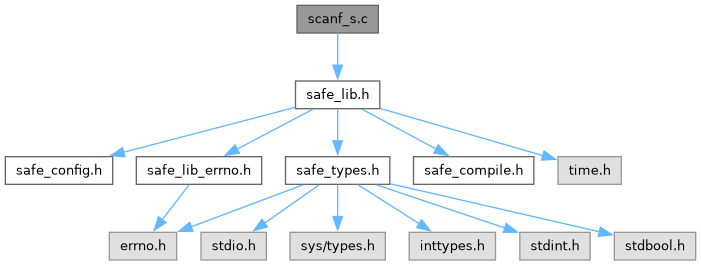
#include "safe_lib.h"Include dependency graph for scanf_s.c:
Functions | |
| EXPORT int | scanf_s (const char *restrict fmt,...) |
The scanf_s function reads a formatted string from stdin, and writes to a list of arguments. | |
Function Documentation
◆ scanf_s()
| EXPORT int scanf_s | ( | const char *restrict | fmt, |
| ... ) |
The scanf_s function reads a formatted string from stdin, and writes to a list of arguments.
Reaching the end of the io buffer is equivalent to reaching the end-of-file condition for fscanf.
- Remarks
- SPECIFIED IN
- C11 standard (ISO/IEC 9899:2011): K.3.5.3.4 The scanf_s function (p: 594) http://en.cppreference.com/w/c/io/fscanf
- Parameters
-
[in] fmt format-control string. [out] ... arguments to write to
- Precondition
fmtshall be a null pointer.-
fmtshall not contain the conversion specifiern -
None of the arguments corresponding to
sis a null pointer. (not yet) - No encoding error shall occur.
-
c,s, and%[ conversion specifiers each expect two arguments (the usual pointer and a value of typersize_tindicating the size of the receiving array, which may be 1 when reading with acinto a single character) and except that the following errors are detected at runtime and call the currently installed constraint handler function. (not yet)
- Warning
- The current implementation just does some basic argument checks and then calls the native
vsscanf()libc function. Thus thesnull pointer check and the two-arg versions ofc,s, and%[ are not yet implemented.
- Returns
- Number of receiving arguments successfully assigned, or
EOFif read failure occurs before the first receiving argument was assigned or if there is a runtime constraint violation.
- Return values
-
> 0 on success, the number of arguments assigned EOF on error
- See also
- vsscanf_s(), swscanf_s(), vsnprintf_s()