ctime_s.c File Reference
#include "safe_lib.h" Include dependency graph for ctime_s.c: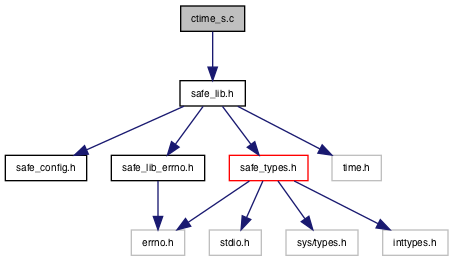
Functions | |
| EXPORT errno_t | ctime_s (char *dest, rsize_t dmax, const time_t *timer) |
The ctime_s function converts the given time since epoch to a calendar local time and then to a textual representation, as if by calling asctime_s(buffer, bufsz, localtime_s(time, &(struct tm){0})). More... | |
Function Documentation
◆ ctime_s()
| EXPORT errno_t ctime_s | ( | char * | dest, |
| rsize_t | dmax, | ||
| const time_t * | timer | ||
| ) |
The ctime_s function converts the given time since epoch to a calendar local time and then to a textual representation, as if by calling asctime_s(buffer, bufsz, localtime_s(time, &(struct tm){0})).
The message is copied into the user-provided dest buffer, which is guaranteed to be null-terminated.
No more than dmax-1 bytes are written, the buffer is always null-terminated. The function does not support localization. Uses the re-entrant ctime_r() if available.
- Remarks
- SPECIFIED IN
- C11 standard (ISO/IEC 9899:2011): K.3.8.2.2 The ctime_s function (p: 624-625) http://en.cppreference.com/w/c/chrono/ctime
- ISO/IEC TR 24731, Programming languages, environments and system software interfaces, Extensions to the C Library, Part I: Bounds-checking interfaces
- Parameters
-
[out] dest pointer to a user-provided buffer. [in] dmax restricted maximum length of dest [in] timer pointer to a epoch (long, seconds since 1970)
- Precondition
- dest and timer shall not be a null pointer.
- dmax shall not be less than 26 and greater than RSIZE_MAX_STR.
- Returns
- Zero if the entire message was successfully stored in dest, non-zero otherwise.
- Return values
-
EOK on success ESNULLP when dest or tm is a NULL pointer ESLEMAX when dmax > RSIZE_MAX_STR ESLEMIN when dmax < 26 or *timer < 0 ESLEMAX when *timer > 313360441200L, the year 10000, resp. LONG_MAX on 32bit systems ESNOSPC when dmax is too small for the result buffer -1 when ctime_r or ctime returned NULL
- Note
- ctime returns a pointer to static data and is not thread-safe. In addition, it modifies the static tm object which may be shared with gmtime and localtime. POSIX marks this function obsolete and recommends strftime instead. The C standard also recommends strftime instead of ctime and ctime_s because strftime is more flexible and locale-sensitive. The behavior of ctime may be undefined for the values of time_t that result in the string longer than 25 characters (e.g. year 10000).
- See also
- asctime_s()