vsnprintf_s.c File Reference
#include "safe_str_lib.h" Include dependency graph for vsnprintf_s.c: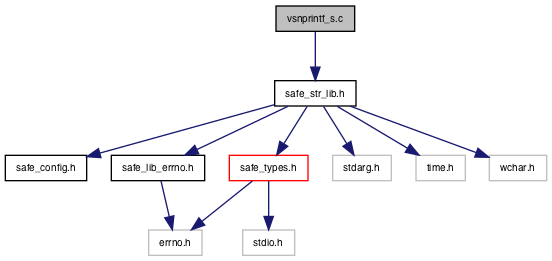
Functions | |
| EXPORT int | vsnprintf_s (char *restrict dest, rsize_t dmax, const char *restrict fmt, va_list ap) |
The truncating vsnprintf_s function composes a string with same test that would be printed if format was used on printf. More... | |
Function Documentation
◆ vsnprintf_s()
| EXPORT int vsnprintf_s | ( | char *restrict | dest, |
| rsize_t | dmax, | ||
| const char *restrict | fmt, | ||
| va_list | ap | ||
| ) |
The truncating vsnprintf_s function composes a string with same test that would be printed if format was used on printf.
Instead of being printed, the content is stored in dest. Warning: Unlike the safe variant vsprintf_s, vsnprintf_s does not guarantee that the buffer will be null-terminated unless the buffer size is zero. More than dmax - 1 characters might be written!
- Note
- POSIX specifies that
errnois set on error. However, the safeclib extendedES*errors do not seterrno, only when the underlying systemvsnprintfcall fails,errnois set.
- Remarks
- SPECIFIED IN
- C11 standard (ISO/IEC 9899:2011): K.3.5.3.12 The vsnprintf_s function (p: 600) http://en.cppreference.com/w/c/io/vfprintf
- only included in safeclib with
–enable-unsafe
- Parameters
-
[out] dest pointer to string that will be written into. [in] dmax restricted maximum length of dest[in] fmt format-control string. [in] ap optional arguments
- Precondition
- Neither
destnorfmtshall be a null pointer. -
dmaxshall not be greater thanRSIZE_MAX_STR. -
dmaxshall not equal zero. -
dmaxshall be greater thanstrnlen_s(dest, dmax). -
fmtshall not contain the conversion specifiern. -
None of the arguments corresponding to
sis a null pointer. (not yet) - No encoding error shall occur.
- Note
- C11 uses RSIZE_MAX, not RSIZE_MAX_STR.
- Returns
- On success the total number of characters written is returned.
- On failure a negative number is returned.
-
If the buffer
destis too small for the formatted text, including the terminating null, then the buffer is set to an empty string by placing a null character atdest[0], and the invalid parameter handler is invoked. Unlikevsnprintf,vsprintf_sguarantees that the buffer will be null-terminated unless the buffer size is zero.
- Return values
-
-ESNULLP when dest/fmtis NULL pointer-ESZEROL when dmax= 0-ESLEMAX when dmax>RSIZE_MAX_STR-EINVAL when fmt contains n
- See also
- sprintf_s(), vsprintf_s()